
 English
  Polski
  Deutsch
  Nederlands
  Svenska
  Norsk
Norsk  Dansk
Dansk  Français
  Italiano
  Español
  Português
  Slovenčina
  Suomi
Suomi  Gaeilge
 A long-lasting crop with minimal care Grow rhubarb in your garden
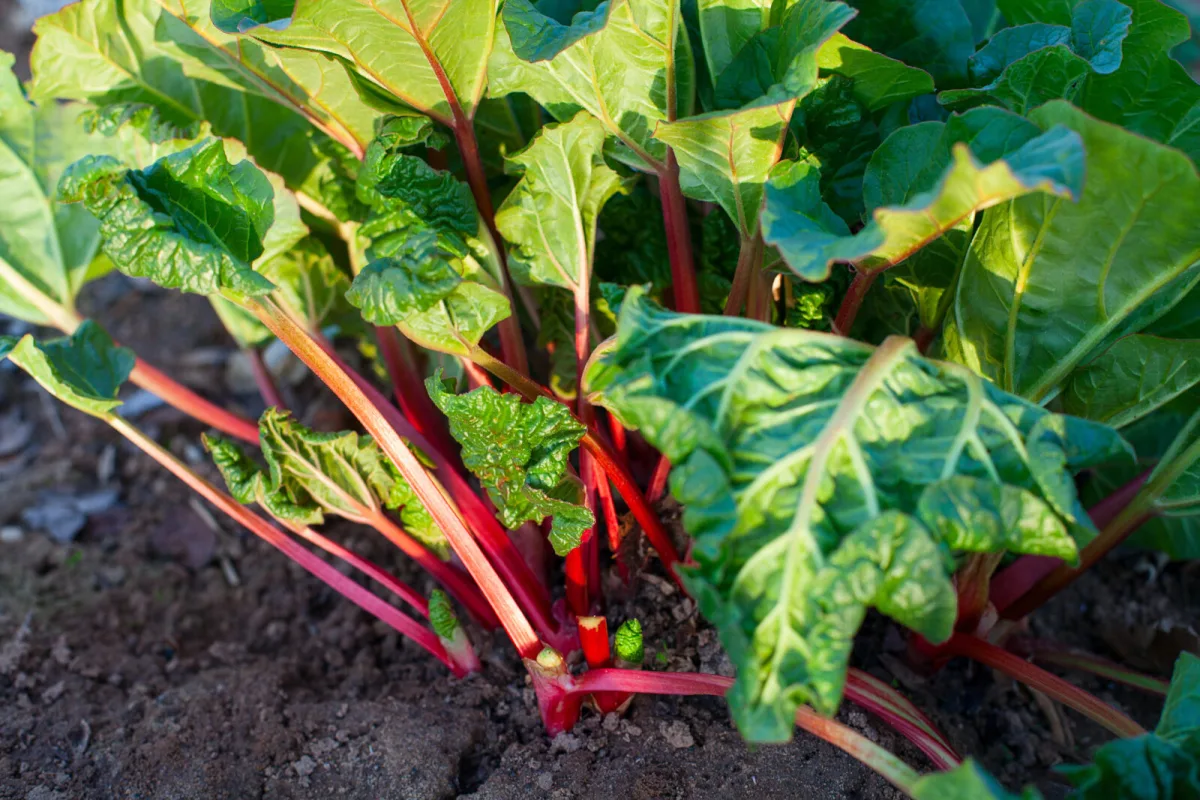
Rhubarb is a long-lived and very hardy perennial that copes well even in cooler locations and doesn’t demand much care. Each spring it re-sprouts and gradually forms a substantial clump of leaves that can spread to around 1.5 m or more, so it needs plenty of space. Over winter the top growth dies back, the leaves collapse, and new stalks appear again in spring. It’s the leaf stalks that are harvested, most often in spring and early summer.
Rhubarb’s flavour varies by cultivar and by the age of the stalks: sometimes sharply tart, other times surprisingly mild. In the kitchen it’s used much like fruit, but botanically it’s a vegetable. It’s a classic in pies and crumbles, but it also works brilliantly in chutneys or as a tangy, savoury note in sauces.
Patience matters with rhubarb. In the first year after planting, you shouldn’t harvest at all; in the second, only very sparingly, so the plant can build strength. From the third season onward you can harvest normally, but it’s sensible to take no more than about a third of the stalks at a time so enough leaves remain to fuel continued growth.
Choosing a variety by colour, flavour, and growing method
Varieties differ in stalk colour from deep ruby through pink to paler shades with a greenish cast. They also vary in vigour, sweetness, harvest timing, and suitability for forcing. If you want to grow rhubarb in a container, it pays to choose a more compact type that won’t demand an excessive amount of space. For winter forcing, early varieties are best, as they respond more readily and deliver an earlier crop.
You can also get rhubarb from other gardeners. Older clumps are typically divided about once every five years to maintain vigour and keep cropping well. Dividing produces several new pieces that are easy to give away or replant elsewhere.
Where to get rhubarb and which form to choose
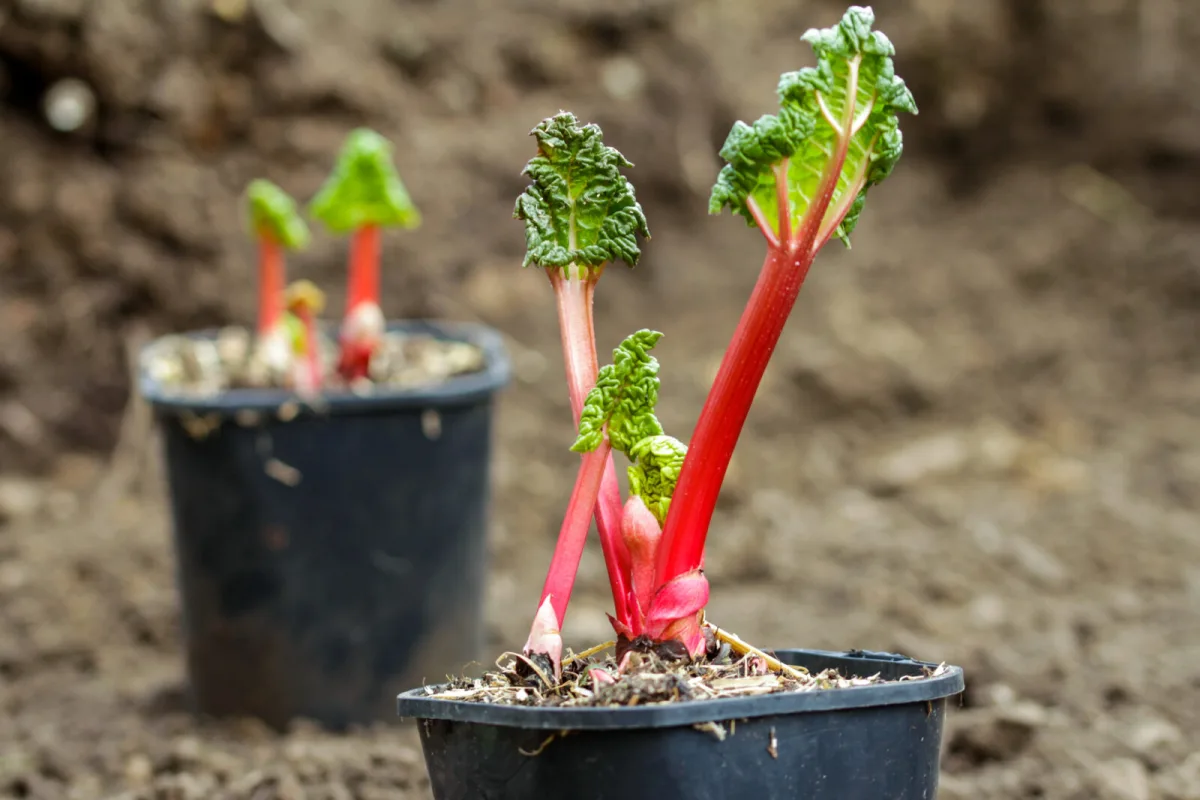
Most commonly, you’ll find potted plants or dormant bare-root crowns. Crowns are usually available from late autumn through early spring and tend to be cheaper than container-grown plants. Seed is the least expensive option, but the wait for a full harvest is much longer, and quality can vary because seedlings won’t be identical to the parent plant. With purchased crowns or plants, choose a reputable supplier so the plants are healthy and free of viral issues.
Preparing the site and soil for the long haul
An open, sunny spot with fertile soil that holds moisture but doesn’t stay waterlogged is ideal. Rhubarb will cope with light shade, but in deep shade it will be weaker. If you have heavy clay soil or poor drainage, it’s safer to grow in a raised bed or a large container. Although rhubarb is fully hardy, young shoots can be damaged by late frosts, so it helps to avoid frost pockets. In colder areas, later-maturing varieties can also be a good fit.
Before planting, remove perennial weeds and improve the soil generously with organic matter. A proven approach is to work in well-rotted compost or thoroughly decomposed manure, roughly two buckets per square metre. If you garden no-dig, you can cover the soil in advance with a thick layer of organic matter and plant straight into it.
Sowing from seed as a cheaper, but slower route
Growing from seed isn’t the quickest or easiest option, but it does allow you to raise more plants for less money. Seedlings start more slowly than purchased crowns or plants with an established root system, and they can differ in growth and stalk quality. If you decide to sow, you can do so in late winter into modules or small pots indoors using a peat-free seed compost, about 2.5 cm deep. Transplant to the permanent position in spring or autumn.
Another option is spring sowing outdoors into a prepared seedbed at the same depth. Once seedlings emerge, thin them gradually, first to smaller spacings and later transplant to a final spacing of about 75–90 cm to allow room for the future clump.
Planting crowns and plants in beds and in pots
Container-grown rhubarb can be planted almost any time, but it establishes best in spring or autumn. It’s best to avoid planting during intense heat and drought. Dormant crowns are sold mainly from November to March, and once they arrive it’s best to plant them as soon as possible.
The planting hole should be slightly wider than the roots. Set the plant so the top of the crown, or the point where the leaves emerge, sits just above the soil surface. Backfill, gently firm the soil, and water thoroughly. When planting more than one, keep a spacing of roughly 75–90 cm.
Growing rhubarb in a container
If your bed often turns into a bog in winter or you don’t have space, rhubarb can be grown successfully in a large container. The pot should be at least 50 cm deep and wide and must have plenty of drainage holes. Use a peat-free, loam-based compost so it holds moisture and nutrients better. Plant the crown so the main bud sits just above the surface. With container growing, plan for more regular watering because compost dries out faster.
Year-round care that keeps the clump strong
Once rhubarb is well rooted, it’s almost fuss-free. The main jobs are removing flower stems, clearing away dying leaves, and mulching in spring. As the clump ages and becomes dense, it benefits from division. If you want very early, tender, paler stalks, you can force it in winter darkness.
Watering and feeding
Young plants need regular watering in their first year during dry spells until they’ve formed strong roots. Established rhubarb usually only needs watering in prolonged drought, as growth slows in heat and dryness. In containers, watering is needed more often throughout the season, but the compost mustn’t stay saturated or root rot can develop.
A mulch of compost usually supplies enough nutrients. If the soil is poor and growth is weak, an organic feed higher in nitrogen in spring or summer will encourage leaf and stalk production. The key is not to overdo it, so the plant isn’t pushed into unnecessary flowering.
Mulching in spring
Each spring, a layer of well-rotted compost or other thoroughly decomposed organic matter about 7 cm thick around the clump works well. Don’t bury the crown, as it can rot if covered. Mulch helps maintain even moisture and suppresses weeds.
Forcing rhubarb for an earlier, more delicate harvest
If you want early, sweeter, more tender stalks, cover a strong, healthy clump in mid-winter with a tall container or a forcing pot so shoots grow in darkness. Once the stalks appear, they grow very quickly and are usually ready to harvest in four to eight weeks. After harvesting the first flush, remove the cover and let the plant continue to grow normally. Don’t force the same clump year after year, as it weakens it.
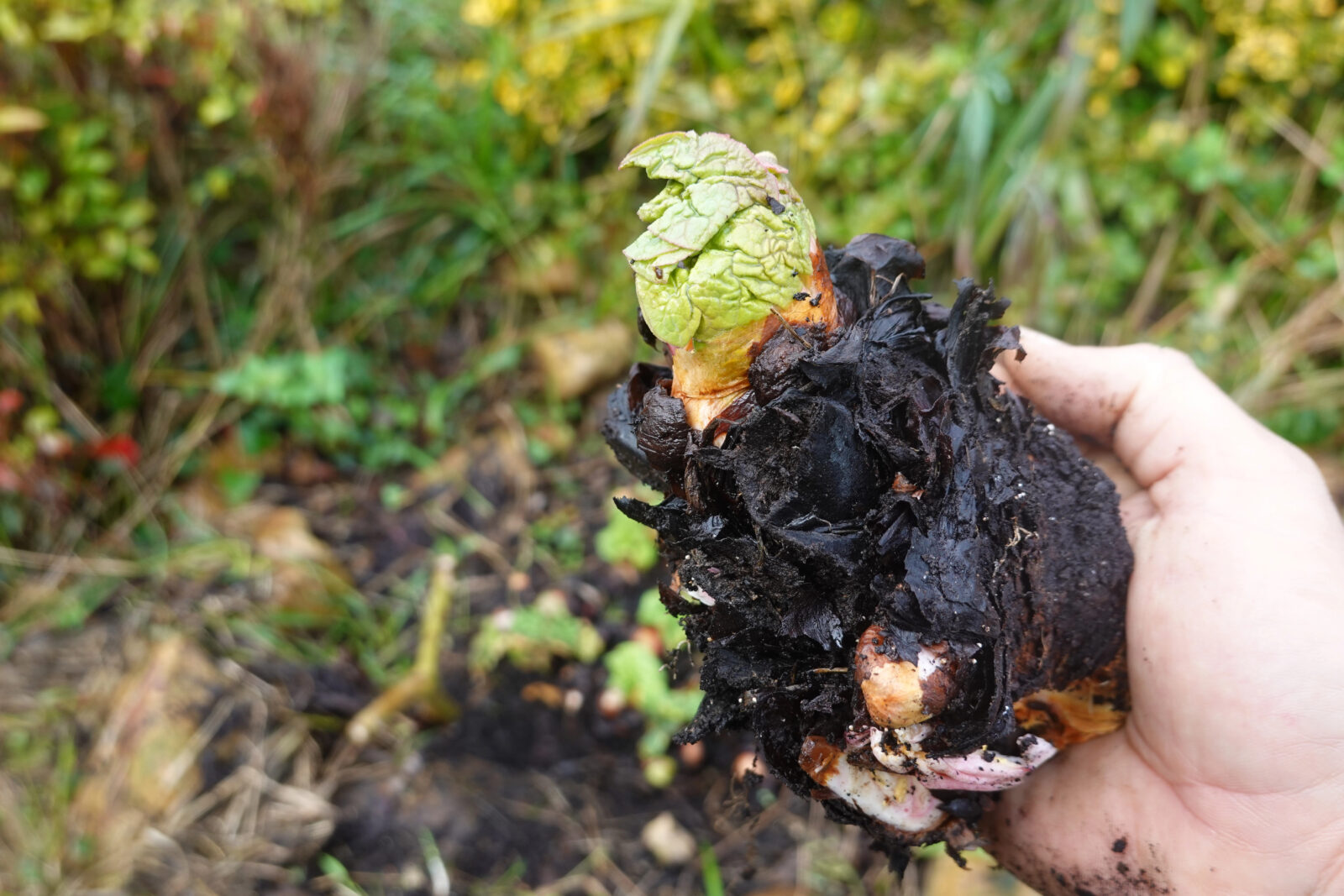
An even earlier method is to lift part of the root in November. Leave the roots outdoors in the cold for up to two weeks to break dormancy, then plant into a container of compost and move it to a cool room or greenhouse at roughly 7–16 °C. Exclude light by covering and keep the compost only lightly moist. Stalks may be ready in about five weeks, but crowns forced this way are often heavily depleted and are frequently not used again after harvest.
Removing flowers and dividing older clumps
If rhubarb sends up a flower stalk, snap or cut it off at the base as soon as possible. Flowering costs the plant energy and can reduce the strength of subsequent stalks. Some varieties flower more often; it’s also more common in seedlings, during very wet summers, or after excessive nitrogen feeding. Old clumps that haven’t been divided for a long time tend to flower more readily as well.
Large clumps are best divided about once every five years, especially if growth is overcrowded or stalks are weakening. Divide during dormancy from mid-autumn to early spring. Lift the whole clump and split it into smaller sections, each with a piece of rhizome and at least one growth bud. Pieces from the outer edge are usually best, while the centre can be tired. Discard weak or rotting sections and replant healthy divisions straight away.
Overwintering made easy
Rhubarb doesn’t need winter protection; in fact, cold is important for a strong spring start. In autumn, let the foliage die back naturally, then remove it so the growing points are exposed to winter chill. Dead leaves can go on the compost heap, as the compounds they contain break down during decomposition.
Harvesting stalks so the plant thrives long term
Don’t harvest in the first year after planting, and in the second year take only a few stalks. From the third year, you can harvest normally. Most varieties start producing stalks from April or May. Although they can still be usable in summer, it’s usually recommended to stop harvesting from late June to early July so the plant can build reserves for the next season.
For harvesting, choose younger stalks about 30 cm long, where the leaf has just fully opened. Grasp the stalk at the base and gently twist and pull it away. Don’t cut it with a knife, as the remaining stub can rot. The leaf isn’t eaten, so remove it and add it to the compost. From one clump, take no more than about a third of the stalks so there’s enough leaf area left for continued growth.
Note: Concerns about higher oxalic acid levels during the season mainly relate to the leaves, which are not eaten. In the stalks, levels are typically low and, with normal use, do not present a toxic problem.
Forced stalks are harvested the same way once they reach about 30 cm. After harvesting a forced batch, remove the cover and leave that clump unharvested for the rest of the season so it can recover.
Common problems and how to prevent them
Rhubarb is generally robust and can last at least ten years, and with regular division much longer. Still, occasional problems do occur. Slugs and snails can damage young shoots, especially the tender ones produced by forcing. Late frosts can scorch emerging growth; if frost is forecast, a temporary cover such as straw or breathable fleece can help.
In persistently wet soil, rot is a risk, especially in winter. Good drainage is crucial, whether that means a raised bed or a container that never sits in water. If dying or softening parts appear, remove them promptly to stop the problem spreading. Sometimes stalks also split lengthwise and may ooze a sticky sap. This is often linked to weather swings, when a cold or dry spell is followed by a rapid improvement and the tissues can’t adapt quickly enough.
Source: Rhs, Almanac , Pestrazahrada.cz
Related articles
The Christmas Amaryllis That Can Bloom for Years but Most People Throw It Away After Flowering
Hippeastrum is a spectacular winter-blooming bulb that, with the right care, will flower again year after year. Learn how to plant it correctly, look after it after flowering, and bring it into dormancy so it reliably reblooms.
How to Grow Winter Garlic for a Much Bigger Harvest
Autumn planting is the key to strong, healthy winter garlic, but the details make all the difference. With the right timing, bed choice, seed-clove treatment and a simple bicarbonate trick, you can noticeably boost yield.
A tree or shrub planted properly in autumn can outpace spring stock and improve fruiting
Many fruit trees and soft-fruit shrubs establish better when planted in autumn, because roots keep growing while the top is dormant. Done well, this head start means stronger spring growth, less watering, and a healthier first year.
Comments (0)
Be the first to comment.