
 English
  Polski
  Deutsch
  Nederlands
  Svenska
  Norsk
Norsk  Dansk
Dansk  Français
  Italiano
  Español
  Português
  Slovenčina
  Suomi
Suomi  Gaeilge
 Do You Pinch Out Tomato Suckers in the Evening You May Be Doing More Harm Than Good
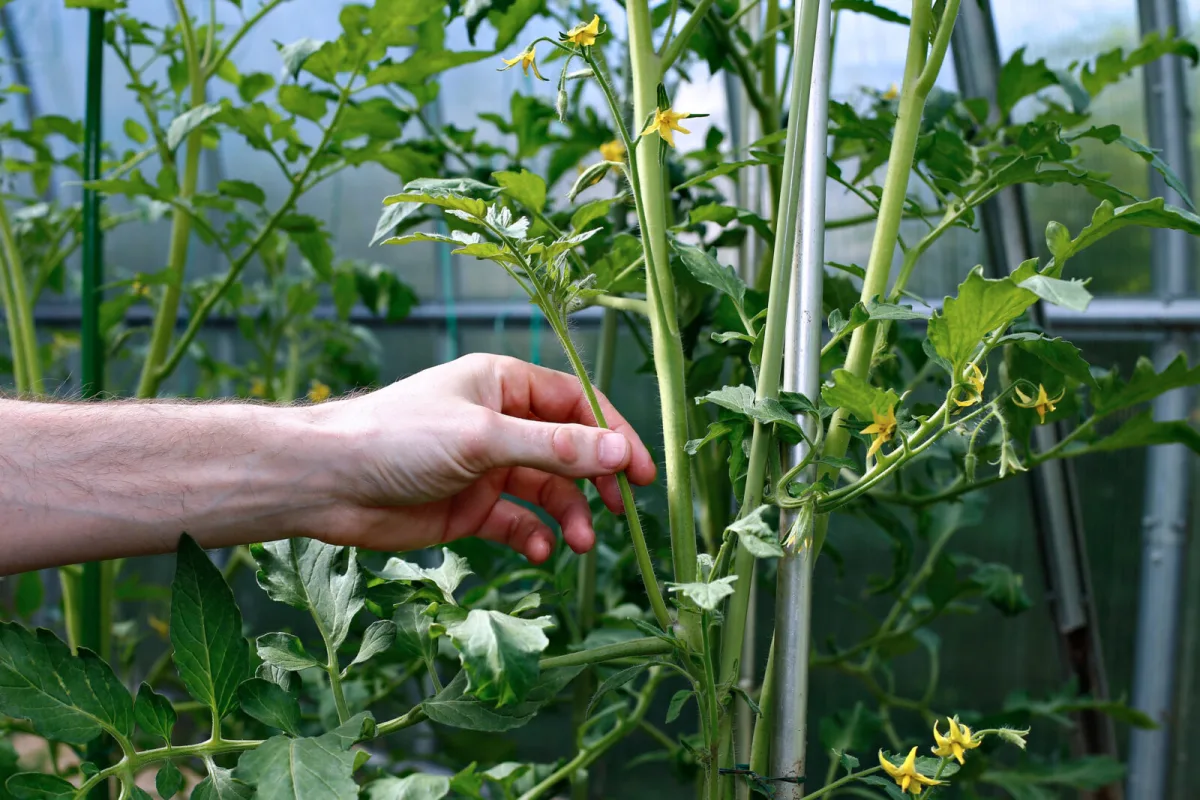
If you want to harvest truly large, sweet fruit from cordon (indeterminate) tomatoes, watering and feeding alone won’t do it. These varieties naturally keep growing and producing more and more side shoots. Without intervention, the plant quickly turns into an impenetrable green mass that may look vigorous, but it spends most of its energy on leaves and stems. The result is lots of foliage and, by the end of the season, smaller fruit that ripens more slowly.
Why suckers are removed and what happens if you leave them
Suckers are side shoots that grow from the leaf axil, the point where a leaf joins the main stem. In indeterminate tomatoes, each of these shoots is essentially the start of a new full plant. If you leave several, the plant spreads its energy in too many directions and often can’t properly support as many flowers and fruits as it sets.
The first issue is wasted energy. The plant sends a large share of sugars and nitrogen into leafy growth instead of supporting flowering and fruit fill. The second issue is microclimate. Overly dense growth doesn’t ventilate well; morning dew and moisture after watering stay on the leaves longer, creating ideal conditions for fungal diseases. Regularly pinching out suckers lightens the plant, keeps it more open, and helps it dry faster.
By removing suckers you’re not harming the plant—you’re simply guiding it to prioritise fruit over endless vegetative growth.
Morning or evening timing decides the quality of the wound
Morning as the safest choice
The best time to pinch out suckers is in the morning. After the night, the plant usually has higher tissue pressure; stems are firmer and the shoot snaps off cleanly with gentle pressure. The wound tends to be smaller and more even. Also, sunlight and air movement act on it during the day, so it dries and seals faster. That reduces the chance of pathogens entering the fresh injury.
Why evening often does more harm than good
In the evening, tomatoes are often a little more limp after a hot day and the tissues are more flexible. Suckers may not break cleanly, and it’s easy to tear off part of the skin or fibres from the main stem. This creates a longer open wound that stays wet for hours overnight as humidity rises. And wounds that remain wet for a long time are among the most common entry points for infection.
Fingers are better than scissors and they also have a hygiene advantage
The simplest and often the safest method is pinching out with your fingers. Grip the sucker between thumb and forefinger and bend it sideways until it snaps. With small shoots it’s quick, and the wound is usually smaller than after cutting.
Scissors can be a problem mainly because of disease spread. If you go from plant to plant with the same tool, it becomes an easy bridge for viruses and other pathogens. If you do need to cut older, thickened, overlooked suckers, it’s sensible to disinfect the blades with alcohol between plants.
Why suckers sometimes regrow in the same spot
It can happen that you remove a sucker and a few days later another appears in the same leaf axil. It’s not a trick of the eye—plants can have more than one dormant bud in these places. In the leaf axil there is a complex of dividing cells that can activate a replacement growing point when the plant interprets the removal as a threat.
This often happens when a sucker is pinched out too early, for example when it is only a few millimetres up to about 1 to 2 cm long, or when a small stub is left behind. It helps to let the sucker grow to around 5 cm, roughly matchstick length. At that stage it can usually be removed along with its growth centre, and regrowth is less common.
It’s a season-long job not a one-off task
Cordon tomatoes grow practically until the first autumn chill stops them. That’s why pinching out suckers is more of a regular summer routine than a one-time job. In practice, checking every 4 to 6 days works well, because young shoots then come away easily without leaving large wounds.
During August, it’s also common to pinch out the tip of the main stem. Once the plant has set roughly five to six trusses, it’s often sensible to stop further growth. The reason is simple: late flowers and tiny fruits won’t have time to ripen before autumn in many areas, so it’s better to focus the plant’s energy on the fruits already hanging there.
The exception when one sucker is kept and the plant is trained to two stems
The basic rule for cordon tomatoes is training to one main stem, but there is a more advanced option—growing on two stems. This is especially suitable for cherry and cocktail varieties, which are very vigorous and carry smaller fruit. Instead of one dominant stem, you create two equally strong, better-balanced leaders that you can tie in separately.
The method relies on choosing the right sucker. Find the plant’s first flower truss; just below it, a shoot in a leaf axil is often among the strongest and most productive. This can be kept as the second main stem. At the same time, two conditions apply: plants need wider spacing so the growth doesn’t become too crowded, and on the second stem you must also remove its own suckers consistently, otherwise the advantage is quickly lost.
Why your fingers turn green after pinching and why itching sometimes appears
When you snap off a sucker, the tomato releases a strong scent and a yellowish sap may seep from the wound. It’s not just harmless plant juice. The stems have fine hairs, and the tissues contain defensive compounds, including the alkaloid tomatine. In nature, these help deter pests and insects that damage the plant.
In more sensitive people, the combination of these substances and aromatic oils can cause itching, stinging, or redness of the skin. If you know you react to tomatoes, wearing gloves helps, and so does washing your hands straight after pinching, so the green staining and irritating compounds don’t stay on the skin longer than necessary.
Source: Gardening Know How, Záhrada, Pestrazahrada.cz

A lover of nature, gardens, and everything that moves, blooms, or grows. He literally grows everything, from herbs to rare species, and he enjoys caring for animals just as much. In his work, he connects modern technology with tried-and-tested grandmotherly methods and is happy when both paths lead to the same goal.
Related articles

How to Keep Your Pool Sparkling Clean Without Unnecessary Effort or Stress
Keeping pool water crystal clear doesn’t have to be hard work. With a simple daily-and-weekly routine, you’ll prevent cloudiness, algae and breakdowns before they start.
A Simple Trick for a Bigger Pepper Harvest and Faster Ripening
Regular watering and feeding aren’t always enough for a heavy pepper crop. Pinching out the growing tips redirects the plant’s energy into branching, flowering, and ripening fruit faster.
Fireflies are disappearing from the landscape, learn how to create a safe garden home
Warm summer nights are even more magical when fireflies start flashing at dusk—but their numbers are falling. With a few simple changes to mowing, planting, lighting and chemical use, your garden can become a safe refuge again.
Comments (0)
Be the first to comment.