
 English
  Polski
  Deutsch
  Nederlands
  Svenska
  Norsk
Norsk  Dansk
Dansk  Français
  Italiano
  Español
  Português
  Slovenčina
  Suomi
Suomi  Gaeilge
 Never prune a walnut tree in spring
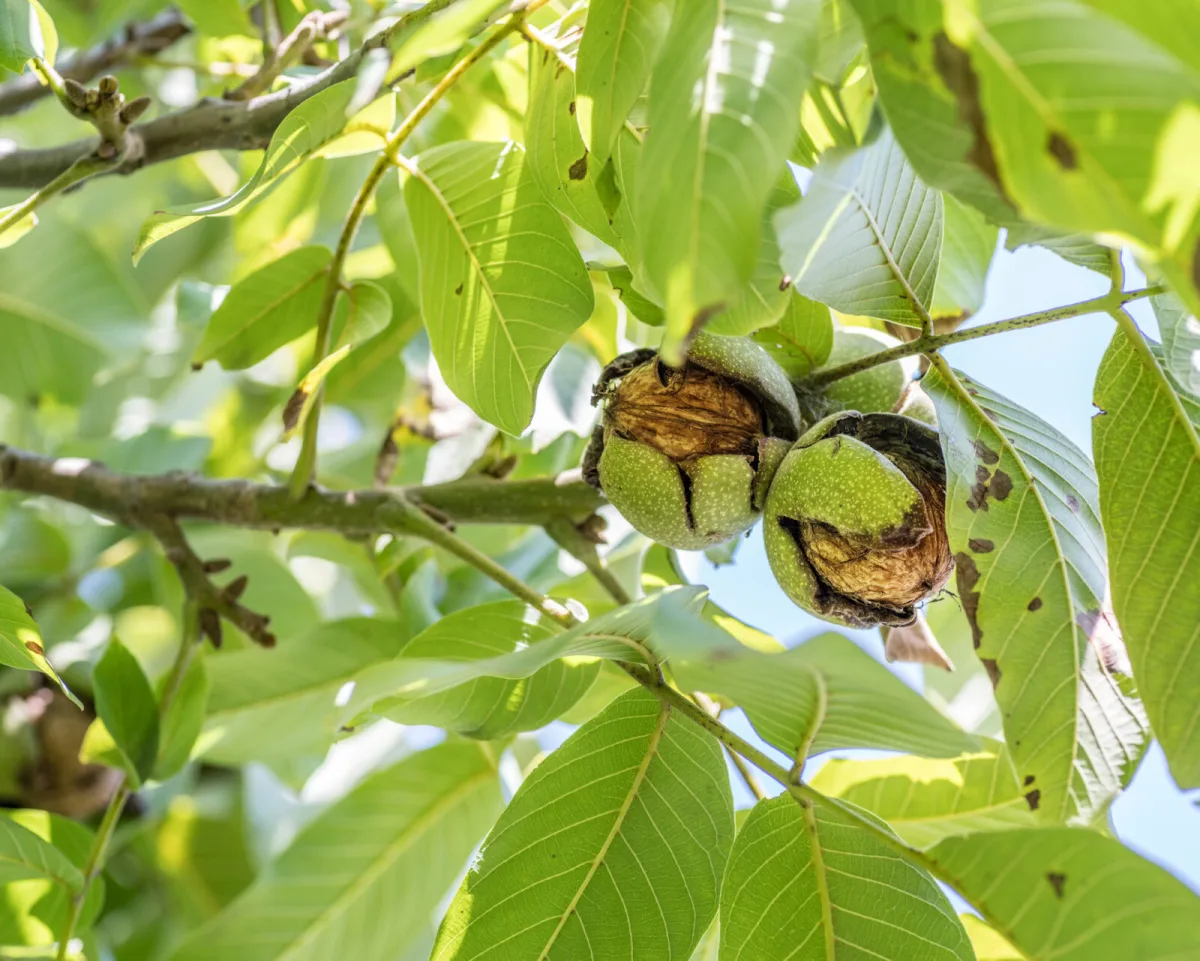
The English walnut is a large deciduous nut tree best suited to more spacious gardens. It can reach impressive height and spread, so you need to allow for its future size at planting time. Although it looks majestic and takes up more room than typical fruit trees, it repays growers with delicious nuts and, once established, usually doesn’t demand complicated care. Grafted trees start cropping relatively early, often after about four years.
What conditions a walnut tree needs
Walnut will tolerate a wide range of soils, but it does best in fertile, free-draining yet consistently moist loam with a higher proportion of alkaline components. Sites where frost lingers are unsuitable, as are exposed positions with strong winds. Late spring frosts can damage young leaves and flowers, which then shows up as a lighter set of nuts.
Full sun is ideal, though young trees will cope for a time with light partial shade. For reliable establishment, smaller young trees—up to around 3 m tall—are best. With walnut it’s important not to damage the main taproot, which is why overgrown or pot-bound plants are often a poor choice.
Planting and spacing between trees
The best planting period runs from late autumn into winter. The tree then has time to root well before vigorous growth begins. Because a walnut’s crown is typically broad, it needs plenty of space. A spacing of roughly 12 to 18 m between trees is recommended.
After planting, it’s wise to stake the tree firmly to a support post. In the first few years it needs regular watering, especially during dry springs and summers. A layer of well-rotted compost spread around the trunk helps greatly with moisture retention. Mulch also suppresses weeds and improves soil condition.
Feeding and supporting growth
For healthy growth and good cropping, it helps to top up nutrients every year. At the end of February you can use a balanced fertiliser, and around the turn of March add nitrogen, for example as ammonium sulphate. Dried poultry manure also works as an alternative. Young trees benefit from consistent care more than older specimens, which tend to be tougher and more self-sufficient.
Pollination and nut set
Some walnut cultivars are partially self-fertile, so they can produce a crop without a second tree. Even so, the harvest is usually noticeably better if another cultivar is grown nearby and cross-pollination takes place. This is especially important where the grower wants a regular, higher yield.
Harvesting and drying walnuts properly
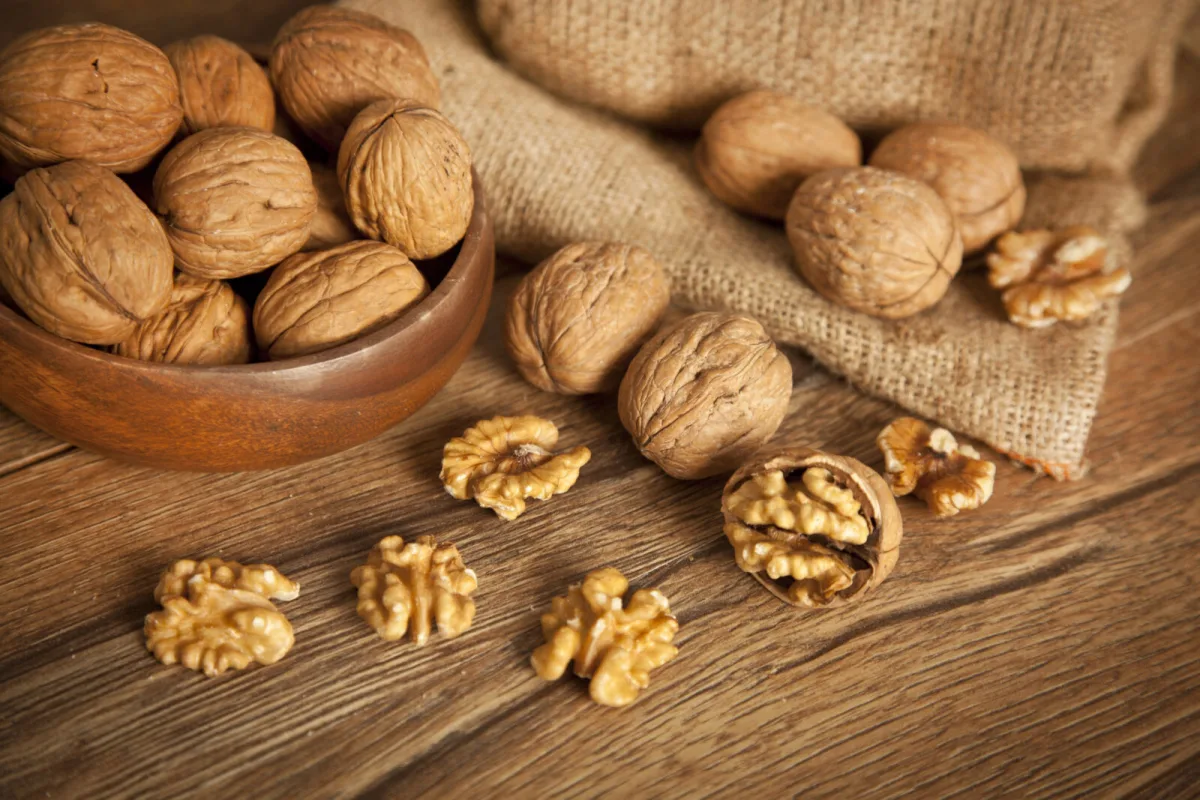
Walnuts ripen in autumn. They sit in a hard shell surrounded by a green, later darkening fibrous husk. As the nuts mature, the outer husk begins to split. Fresh walnuts can be eaten straight away, but the kernel often has a less pleasant, sometimes slightly rubbery texture. Much more commonly, they are dried.
Before storing, it’s a good idea to crack a few of the first nuts to check that the kernel is fully developed. If it is, remove any remaining husk from the nuts—otherwise mould may develop. It’s sensible to wear gloves when cleaning, as the husk stains skin heavily. The nuts are then finished off at a low temperature, no more than about 40 °C, and stored in a cool, dry place.
It’s best to gather nuts daily, because birds and squirrels quickly discover fallen fruits. In cooler areas, nuts may not fully colour up or ripen. Such fruits can still be used while green, for example for pickling, but only until the outer husk hardens. Overripe nuts with a softened, blackened husk are not ideal, as they can negatively affect the flavour of the kernel.
Pruning and shaping the crown
A walnut can be trained with a strong central leader, or adjusted to branch more laterally. Removing the leader helps create a broader crown and also partly limits the tree’s overall size. Side shoots can be pinched back to around the fifth or sixth leaf to encourage denser growth.
Regular pruning is usually not necessary. Most often it’s enough to remove dead, damaged or awkwardly crossing branches. Timing is crucial. Walnuts are prone to heavy sap bleeding from wounds, so prune from mid-summer to early autumn. Very deep cuts or severe pruning are poorly tolerated.
Propagating walnut
Propagation from cuttings is not very reliable, as rooting tends to be weak. For named cultivars, grafting or budding onto seedlings of English walnut or black walnut is therefore used more often. Anyone wanting to raise a tree from seed can sow fresh nuts—after removing the green husk—into a free-draining medium. Plant the seeds about 3 cm deep. Young seedlings can then be used later as rootstocks for selected cultivars.
Recommended cultivars for the garden
Popular cultivars include Broadview, which grows more slowly, has a more compact habit and is often disease-resistant. It frequently gives a heavy crop of medium-sized, good-quality nuts after only a few years. Buccaneer is also worth considering; it’s a faster-growing cultivar with a more upright shape. It is self-fertile and begins fruiting after roughly four years. A newer cultivar is Lara, valued for its resilience and large nuts on a moderately vigorous tree.
Potential problems when growing walnuts
Although walnut is generally quite hardy, certain issues can arise. Squirrels can cause major crop losses, as they can harvest almost every nut before the gardener does. Helping measures include protecting the trunk with a smooth plastic guard and raising the lowest branches to a height that makes it harder for pests to reach the canopy.
Galls or leaf spots may appear, such as anthracnose and other fungal diseases. Chemical control is not usually the go-to option; more important is careful clearing up of affected leaves, which breaks the infection cycle. Occasionally, the fruits may also be damaged by tortrix moths.
The effect of walnut on nearby plants
Walnut trees release substances into the soil that can slow the growth of some other plant species. This is known as allelopathy. In English walnut the effect is usually less pronounced than in black walnut, but it’s still worth allowing for when planning plantings. More sensitive plants can include tomatoes or apple trees.
A walnut is a tree for many decades. Given enough space, sun and protection from late frosts, it becomes a valuable part of the garden and a regular source of quality nuts.
Source: RHS, The Spruce, Pestrazahrada.cz
Related articles
Homegrown Physalis Tastes Better Than Store Bought But Green Fruit Can Be Toxic
Cape gooseberry (Physalis peruviana) rewards you with aromatic, sweet-tart fruit when grown in a sunny, sheltered spot. Learn how to raise plants from seed, care for them, and why unripe green fruit should never be eaten.
Autumn asters turn the garden into a haven for pollinators
Autumn asters light up borders in September and October with clouds of colour while offering vital nectar and pollen when many other plants have finished. Chosen well, they’ll keep feeding pollinators right up to the first proper frosts.
Autumn perennials bloom when everything else is winding down and keep the garden glowing until frost
When summer crops and bedding flowers are fading, the garden doesn’t have to look tired. Choose the right autumn-blooming perennials and you can enjoy rich colour right up to the first frosts.
Comments (0)
Be the first to comment.