
 English
  Polski
  Deutsch
  Nederlands
  Svenska
  Norsk
Norsk  Dansk
Dansk  Français
  Italiano
  Español
  Português
  Slovenčina
  Suomi
Suomi  Gaeilge
 Watch out for a new tick species in the Czech Republic
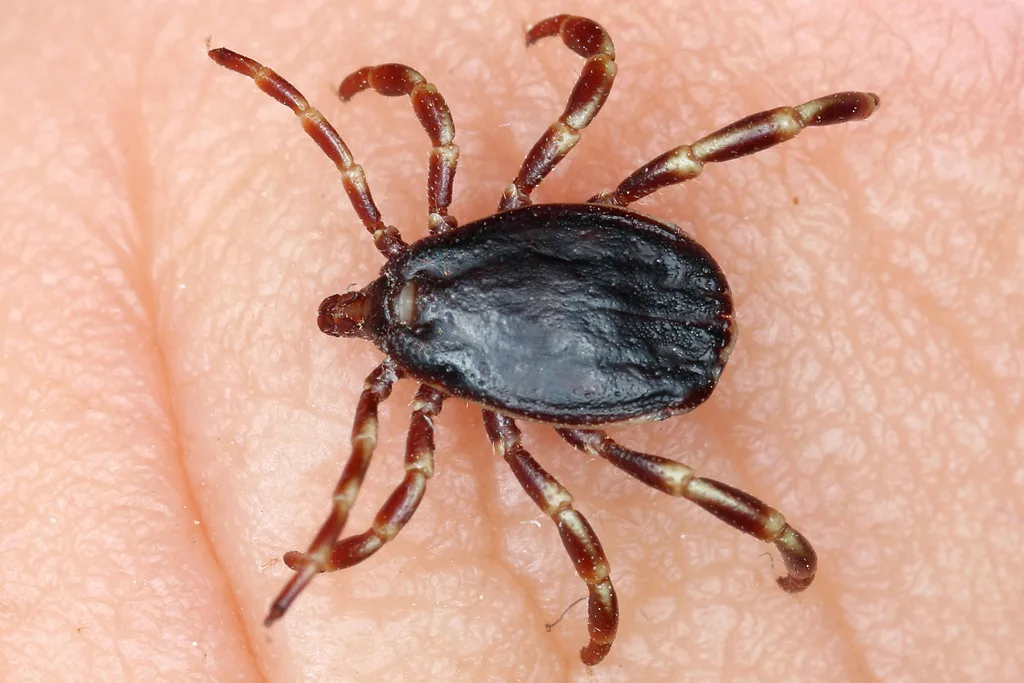
In recent years, the Czech countryside has also seen ticks of the Hyalomma genus, most often arriving indirectly via migratory birds. These can carry the younger life stages over long distances and, after reaching Central Europe, the parasite can continue developing if conditions are favourable. Warmer weather and longer periods without frost also help it significantly, making survival at our latitude easier.
Experts stress that this is not any kind of large-scale invasion. So far, records have been mostly isolated cases, but the situation is being monitored over the long term because the appearance of new parasite species is sensitive to climate change as well as changes in the landscape.
A larger body and striped legs give it away at first glance
Unlike the common castor bean tick, adult Hyalomma can be noticeably more robust, in some cases several times larger. This sturdy build is one reason people often spot it more easily, for example on clothing or in an animal’s coat.
A typical identifying feature is its distinctly striped legs, which can look almost exotic. Combined with its larger size, the tick may be alarming, but appearance alone does not automatically mean a higher risk of infection.
It doesn’t wait passively in grass and can run after a host
Hyalomma differs in behaviour as well. While local species often lie in wait in vegetation and rely on accidental contact, this species is, in some situations, able to actively seek out a host. In practice, that means it may not just sit still in a suitable spot, but can move across the ground towards an animal or a person and cover several metres.
It prefers dry, sunny sites, which is why it’s more often associated with open landscapes than with damp woodland undergrowth. That is also why it is mentioned, for example, in connection with grazing land and drier meadows.
Grazing horses are often hosts
In the field, Hyalomma is more commonly found on larger animals, typically those that move across open ground. The hosts most often mentioned are grazing horses, where the parasite has good conditions to attach and can more easily end up in the kind of habitat that suits it.
That does not mean it cannot latch onto people as well. For everyday visitors to the countryside, it makes sense to remember that checking yourself after being outdoors is worthwhile even outside classic forest habitats.
Diseases linked to Hyalomma are, for now, only a theoretical threat here
In some parts of Africa and also in areas of southern Europe, Hyalomma is associated with the transmission of serious infections, including Crimean-Congo haemorrhagic fever. Even so, it does not currently pose a major health risk to people in the Czech Republic.
The reason is simple: the presence of the tick alone does not mean the relevant virus will automatically be present in nature. That requires a more complex chain of transmission between multiple hosts and suitable ecological conditions. Those are usually lacking in our environment so far, which is why the potential risk is considered low. Nevertheless, the situation is monitored by European institutions and specialist bodies.
The more realistic problem remains the common tick and the diseases it spreads
From a day-to-day perspective, the far greater danger in the Czech Republic is still the castor bean tick. It is widespread, and people come into contact with it in gardens, parks, and along woodland edges. This common species is behind a large number of cases of Lyme disease and also tick-borne encephalitis.
Infection numbers are also driven by milder winters and a long season, with ticks active from spring right through late autumn. There is an effective vaccination against encephalitis, and for some people it is more accessible thanks to health insurance coverage.
Prevention works the same for large and small ticks
Protection against Hyalomma is essentially no different from protection against common species. A repellent helps, and it makes particular sense to apply it to footwear and the lower parts of trouser legs, where ticks most often make their way onto the body.
It’s also practical to choose smoother, lighter-coloured clothing, on which the parasite is easier to spot before it bites. After returning home, a thorough skin check is important, especially behind the knees, in the armpits, in the groin, and behind the ears. Consistency with these steps often determines whether you notice a tick in time.
Be alert, not alarmed
The presence of Hyalomma in the Czech Republic is a reminder that nature is changing, and with warming temperatures, species that used to belong more to warmer regions may begin to appear. Still, there is no reason for hysteria. It’s wiser to stay calm, follow expert guidance, and stick to proven prevention that protects against ticks regardless of their size or origin.
Source: Deník, Forum24, iNaturalist, Pestrazahrada.cz

A lover of nature, gardens, and everything that moves, blooms, or grows. He literally grows everything, from herbs to rare species, and he enjoys caring for animals just as much. In his work, he connects modern technology with tried-and-tested grandmotherly methods and is happy when both paths lead to the same goal.
Related articles
Why the Tree That Feeds a Family for Generations Is Disappearing from Czech Gardens
The English walnut used to be a staple of larger gardens and farmyards, valued for its nutritious nuts and many practical uses. With the right site and variety, it remains one of the most rewarding long-lived trees you can plant.

How to Get Rid of Mice and Rats in the House, Loft and Garden Effectively
Mice and rats don’t leave quietly—scratching sounds, droppings and gnaw marks are clear warnings. A lasting solution comes down to three steps: block entry points, remove food sources, then use traps or professional control.
Two Mistakes When Harvesting Onions Can Cut Your Supply by Months
With good growing and the right handling, onions can turn into a near year-round pantry staple. These simple harvest and curing steps determine whether they keep for weeks or for months.
Comments (0)
Be the first to comment.