
 English
  Polski
  Deutsch
  Nederlands
  Svenska
  Norsk
Norsk  Dansk
Dansk  Français
  Italiano
  Español
  Português
  Slovenčina
  Suomi
Suomi  Gaeilge
 Hardy Geranium Turns Beds and Difficult Spots into a Beautiful Carpet of Flowers
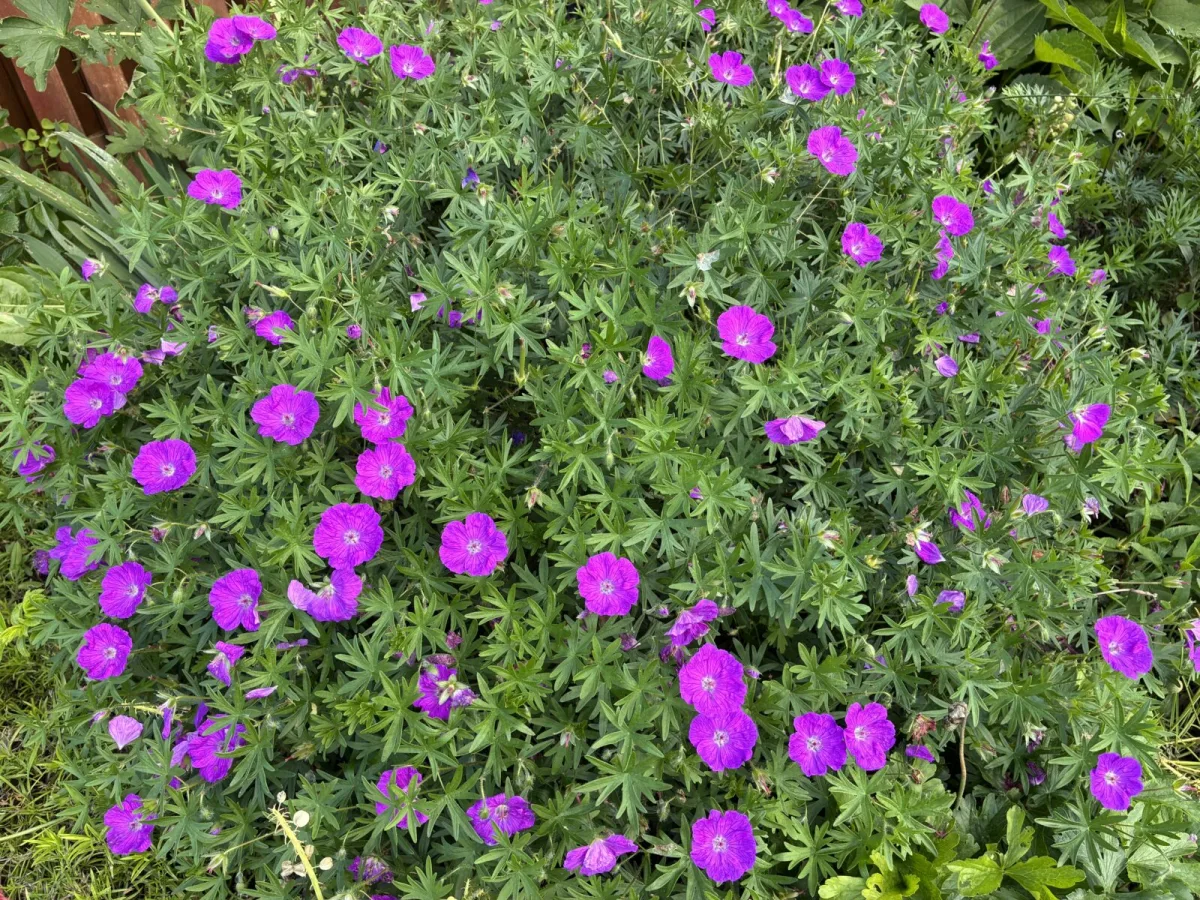
Anyone who designs perennial borders often runs up against shifting trends. Some plants become garden stars for a few years, only to be replaced later by the next wave of novelties. Hardy geraniums, the genus Geranium, don’t belong in that category. On the contrary, they’ve long proved they can adapt to almost any planting style. They look natural in a romantic cottage garden, read crisp in modern urban compositions, and they also do well in containers, where they form compact, long-lasting, attractive clumps.
Their big advantage is tremendous diversity. There are so many species, cultivars, and hybrids that you can choose a plant for sun, part shade, or shade, for moisture-retentive soil as well as drier positions. Thanks to this, hardy geraniums often work as the linking element in a border, filling gaps, suppressing weeds, and never looking heavy-handed.
Rising popularity in Europe and the first major return to borders
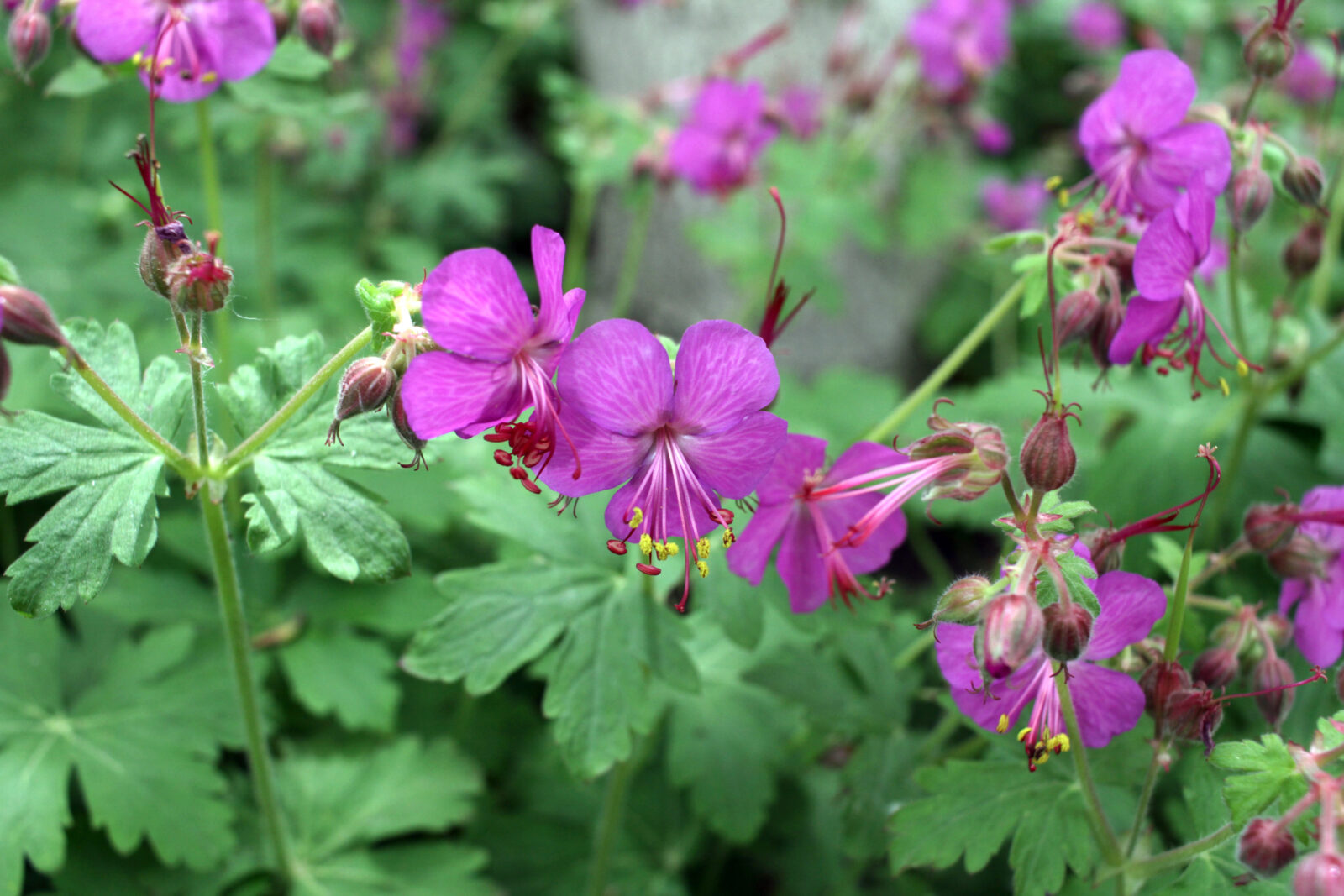
A stronger wave of enthusiasm for hardy geraniums in Europe rose in the early 1980s. Plantings at the time very often featured bigroot geranium (Geranium macrorrhizum), mainly thanks to its toughness. It grows quickly, copes with competition from tree roots, and some forms stay green even through winter. The flowers can be rather understated, often white or pale pink, but the overall effect of the dense cover is exceptionally practical. That’s exactly why it proved itself as large-scale groundcover beneath trees, where other perennials often struggle.
A different role in the garden is played by Geranium x magnificum (G. x magnificum). It established itself especially as a partner to more striking plants, for example roses or delphiniums. It offers larger blue-purple flowers that draw the eye, while still keeping the natural look typical of hardy geraniums. From more recent breeding, gardeners also take note of the cultivar Rosemoor, valued for even growth and handsome flowering.
Hundreds of cultivars and different needs by species
The vast breadth of choice is largely thanks to breeders in England and the Netherlands, who have worked with hardy geraniums for generations. Today, hundreds of options appear on the market, from original botanical species to garden cultivars and hybrids. Although requirements for light and soil vary, most hardy geraniums share the same strengths: they are resilient, reliable, and don’t demand complicated care.
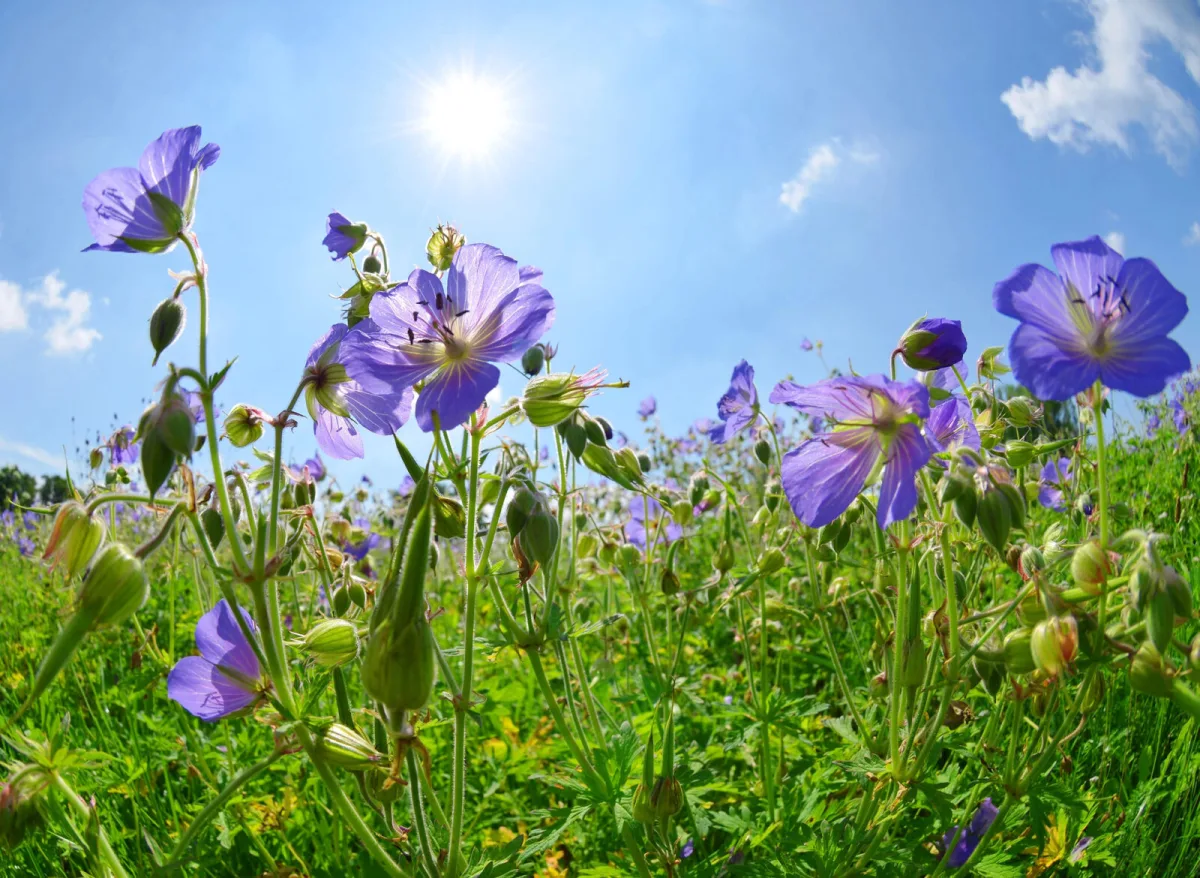
For sunny borders with richer soil that doesn’t bake dry, taller, large-flowered types derived from the native meadow cranesbill (Geranium pratense) are a good fit. Cultivars in this group can reach around 60 cm and offer abundant flowering in shades of blue. By contrast, where soil is leaner and drought is the rule, bloody cranesbill (G. sanguineum) and its lower cultivars around 30 cm perform beautifully. These plants cope with heat and longer periods without watering, yet still form compact, tidy clumps.
Ornamental foliage as a major strength of hardy geraniums
Modern garden design increasingly treats foliage as a full-fledged ornamental feature. In this respect, hardy geraniums can be a pleasant surprise, because they offer not only flowers but often very decorative leaves with strong texture. An interesting choice is Renard’s geranium (G. renardii), with soft, grey-green to sage-toned leaves. It looks delicate and elegant, so it pairs well with plants that have bold blooms or dark foliage.
If your aim is a bolder, higher-contrast border, Geranium pratense ‘Black Beauty’ (G. pratense) will catch the eye with its purple-tinged leaves. Combined with the pale flowers of neighbouring perennials, it creates a strong effect even outside peak flowering time, extending the overall appeal of the planting.
Simple maintenance is enough to keep hardy geraniums vigorous
Among the few tasks worth doing with hardy geraniums is removing spent flower heads. The planting then looks tidier and, at the same time, you reduce uncontrolled self-seeding, which can be surprisingly vigorous in some species. If a plant spreads too far or loses its compact shape, it also tolerates a harder cut back to a few centimetres above the ground. In large groundcover plantings, the whole patch can be shortened quickly, for example with hedge shears.
After cutting back, it’s a good idea to give the plants nutrients and moisture so they can re-sprout quickly. In some groups, especially cultivars derived from wood cranesbill and meadow cranesbill, a second flush of flowers may follow, so this simple intervention brings freshness back to the border. Late autumn cutting isn’t ideal, particularly for species that stay green in winter. Their leaves often serve a protective function and also keep the planting decorative outside the main season.
Dividing clumps in March as the quickest way to propagate
Hardy geraniums are perennials that can grow over time into large clumps. That’s exactly why they’re easy to propagate and also practical if you want to fill new areas of the garden or rejuvenate an older planting. Most commonly they are divided in spring, ideally in March, when the plant is starting the new season.
The method is straightforward. Lift the clump carefully, ideally with a garden fork so the root system isn’t damaged unnecessarily. Split the root ball into several sections and plant the pieces into loosened soil. Water thoroughly after planting so the plant establishes quickly and doesn’t stall in growth.
Where to plant hardy geranium so it thrives long term
The strength of the genus Geranium is that it offers a solution for most garden sites. For sunny yet moisture-retentive spots, suitable choices include G. endressii, G. himalayense, G. x magnificum, G. pratense or G. psilostemon. Where there is more part shade and the soil holds moisture, G. gracile, G. himalayense and G. sylvaticum come into their own.
For sunny, dry sites, tough types such as G. sanguineum, G. renardii, G. x cantabrigiense or G. cinereum are suitable. And if you have shaded spots in the garden that are also dry, that’s often where hardy geranium shows its greatest strength. G. macrorrhizum, G. nodosum and also G. phaeum work reliably there, able to form a viable cover even in conditions where many other perennials fail.
Hardy geranium isn’t just one plant, but a broad group of perennials from which you can choose a form for almost any light, soil, and garden style.
Source: NKZ, Almanac, BBC Gardeners, Wikipedia, Pestrazahrada.cz
Related articles
Autumn strawberry care takes an hour and you will be rewarded with plants laden with fruit with just three steps
After fruiting, strawberries benefit from a few timely autumn jobs that help them winter well and bounce back strongly in spring. A simple trim, the right feed, and a protective mulch can mean bigger, tastier berries next season.
Christmas cactus will bloom again even after years if you avoid one common mistake
A Christmas cactus can look perfectly healthy yet refuse to flower for years. With the right light, temperature, watering, and a gentle boost, it can set buds again and bloom reliably.
Take care with pruners on ornamental grasses Some are best cut back in autumn others in spring
Ornamental grasses bring movement and structure, but not all of them should be left standing until spring. For several warm-season and self-seeding types, an autumn cut-back keeps borders tidier and helps limit spread.
Comments (0)
Be the first to comment.