
 English
  Polski
  Deutsch
  Nederlands
  Svenska
  Norsk
Norsk  Dansk
Dansk  Français
  Italiano
  Español
  Português
  Slovenčina
  Suomi
Suomi  Gaeilge
 Forget the Fear Black Carpenter Bees Help Czech Gardens Thrive
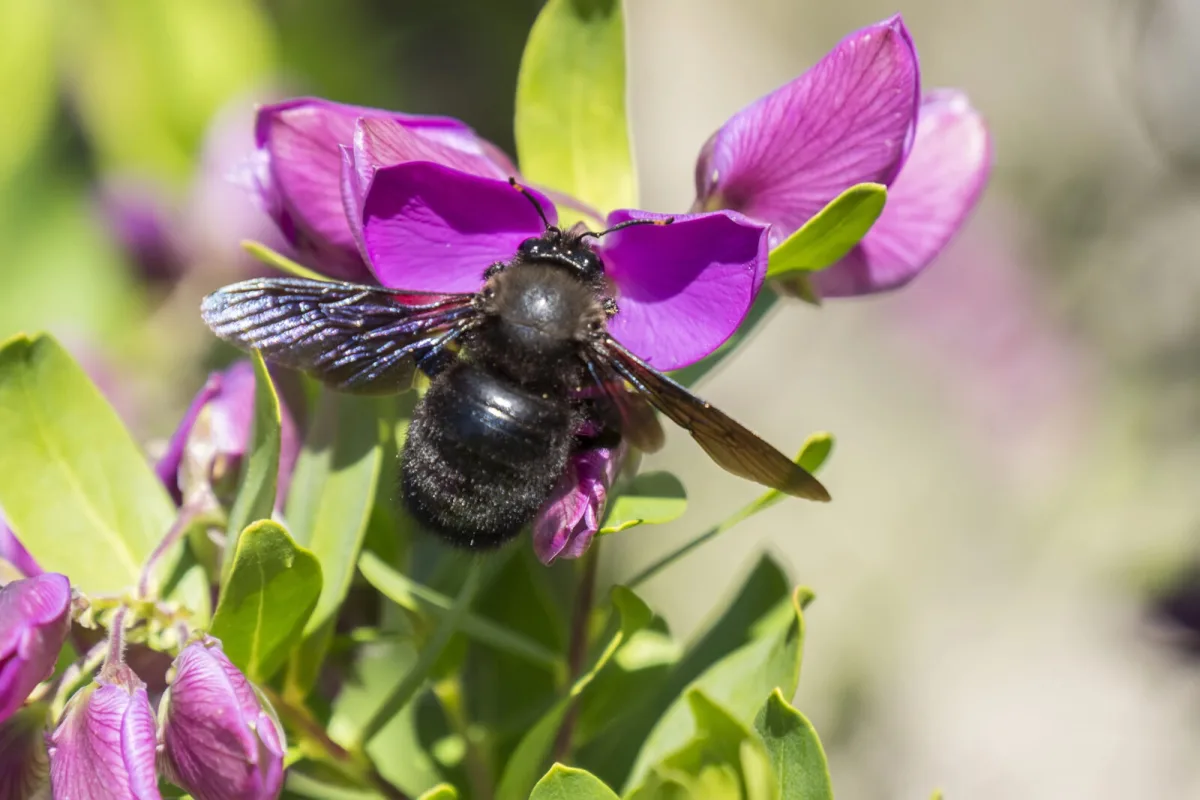
In spring and summer, a strikingly large black bee may appear in the garden, buzzing loudly in flight, with wings that flash a metallic blue-violet in the sun. Most often it’s the violet carpenter bee, one of the largest bees found in the Czech Republic. Adults are usually about 2 to almost 3 cm long, and the wingspan is impressive, so it’s noticeable even from a distance.
Unlike the honey bee or many bumblebees, the carpenter bee doesn’t form large colonies. The female lives independently, without workers and without building wax comb, she doesn’t make honey, and her entire life revolves around finding food, establishing nesting cells, and caring for the next generation.
When it’s active and where it overwinters
In our conditions, it can usually be seen from early spring until the end of September. It doesn’t overwinter as a larva, but as an adult. It looks for shelter in cracks in old trees, in splits in beams, and sometimes even in gaps in masonry. Mating takes place around May, and with a bit of luck you may spot two individuals flying close together. New adults then appear the following spring.
How not to confuse it with a bumblebee or a hornet
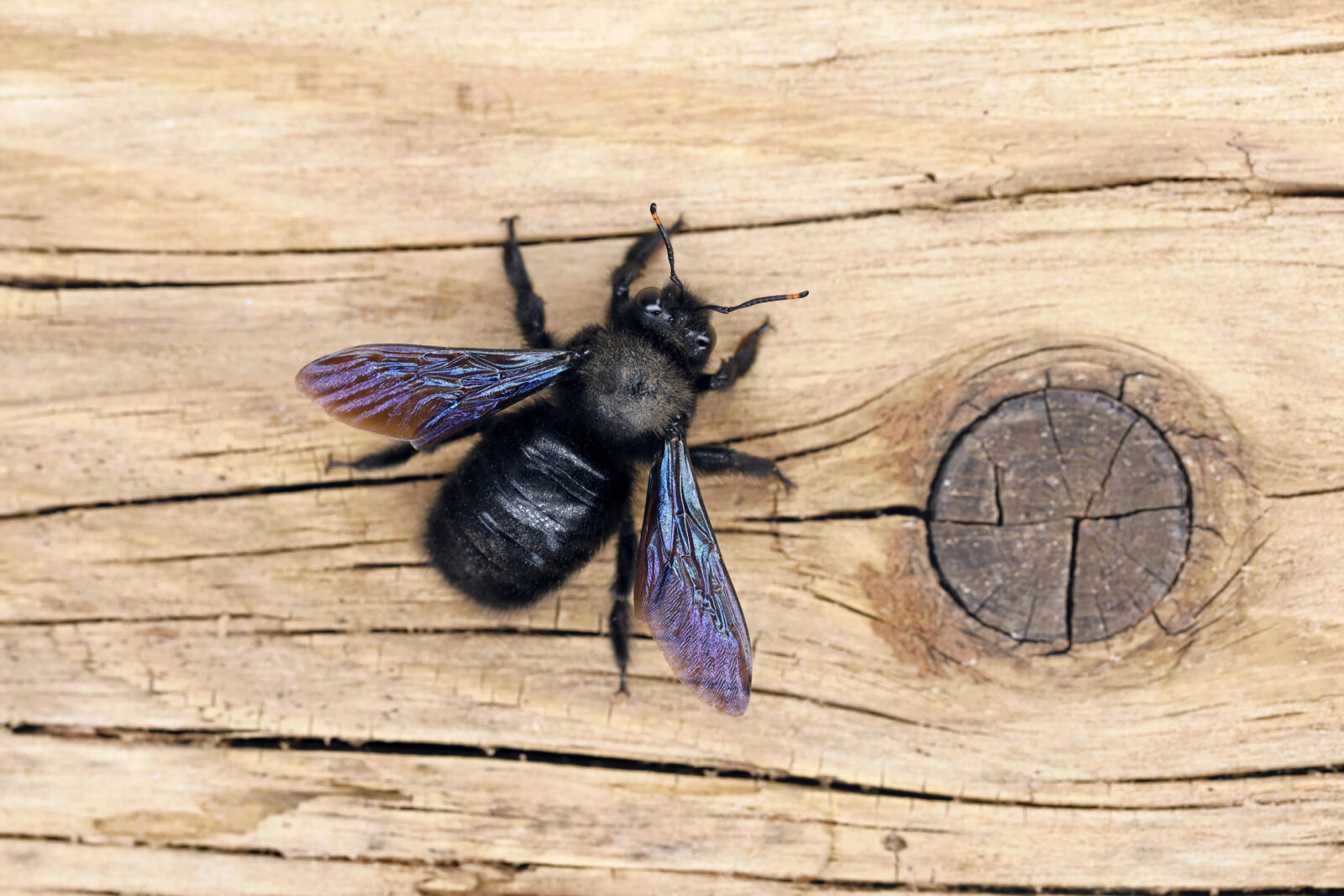
People often refer to it as a black bumblebee or a big wasp. The key features are an overall black body that is fairly glossy and less hairy, and dark wings with a purple or bluish sheen. Our native bumblebees, wasps and hornets are not typically uniformly black without obvious yellow or brown markings. A very similar species is also the wandering carpenter bee, which in some regions occurs just as often, or even more often.
Will a carpenter bee sting a person and is it dangerous?
Carpenter bees are generally calm and will usually avoid people. When one flies close to your head, it’s typically just curiosity or searching for flowers and shelter, not an attack. Stings usually happen only when the bee is pressed, caught in a hand, stepped on, or when someone tries to kill it.
Only the female can sting. The pain is often comparable to a wasp sting, but the venom is generally considered less toxic than that of the honey bee. Unlike a honey bee, it doesn’t die after stinging, so there’s usually no need to remove a stinger because it isn’t left in the skin. Severe reactions are rare and are mainly linked to serious allergy to insect venom. If a carpenter bee flies into a room, opening a window and giving it time to leave on its own is usually enough.
Why it’s valuable in the garden and how it pollinates
Carpenter bees are important pollinators, and in many places they’re regarded as a rarer species that deserves protection. Ecologically, they’re also beneficial because they can perform buzz pollination. They vibrate the flower with rapid wing movements so pollen is released more easily. Honey bees can’t do this, but bumblebees and a few other solitary bees can.
In practice, this means some plants may set better fruit thanks to carpenter bees. Tomatoes are often mentioned, along with some soft fruit and flowers with deeper structures where pollen needs to be released more efficiently. While foraging, a carpenter bee can visit hundreds of flowers in a single flight, doing work in the garden that isn’t easy to replace.
When it takes an interest in old beams and dry wood
The name “carpenter bee” isn’t accidental. The female can chew a tunnel into dry wood and create a series of cells inside it. She’s most attracted to old, dead, easily worked wood: stumps, dead branches, rotten posts, wooden fences, or unprotected parts of pergolas. Sound, treated, and regularly maintained structural timber is usually not attractive to her.
A typical tunnel is several tens of centimetres long, and inside are cells stocked with pollen and nectar and laid with eggs. A single tunnel usually won’t significantly compromise the strength of a substantial beam. And because it isn’t a social insect, you generally don’t face a situation where thousands of individuals suddenly appear in one place within a short time, as can happen with some social species.
How to proceed gently if you need to protect the wood
If the entry holes bother you in a specific element, it’s sensible not to intervene while the nest is occupied. During the season there may be larvae or pupae inside. It’s better to wait until late autumn, when the young adults have emerged and the tunnel is left empty. Only then should you seal the hole with filler, and then treat the wood preventively so it’s no longer attractive to carpenter bees.
Offering an alternative can work well too. If you leave a piece of dry wood at the edge of the property or create suitable cavities, carpenter bees will often prefer the more accessible material and won’t try to use the particular beam you want to keep hole-free.
Which sprays to choose for aphids so the carpenter bee doesn’t suffer
The greatest risk to carpenter bees and other pollinators isn’t the insects themselves in the garden, but poorly chosen insecticides. Many chemical products act as neurotoxins and can harm beneficial species that pollinate flowers or control pests naturally. If you need to deal with aphids, spider mites, or whitefly, it pays to choose gentler methods and sprays with contact action.
Contact products based on potassium salts
One of the safest options is generally considered to be a product based on potassium salts of fatty acids, often sold under the name Neudosan. It works by disrupting the protective outer layer of soft-bodied pests, causing them to dry out and suffocate. It isn’t a nerve poison, and once it has dried on the plant it’s usually regarded as substantially less risky for bees, bumblebees and carpenter bees than conventional insecticides.
For maximum consideration, apply the spray early in the morning or in the evening, when pollinators are less active than in the middle of the day. It’s also important to target the infested parts of the plant because the effect is contact-based and depends on good coverage of the pest. Some versions are sold pre-diluted in a trigger spray bottle, which makes precise, local application easier.
Other pollinator-friendly plant protection options
If you’re dealing more with fungal diseases, you can use biological or mineral products which, when used correctly, are considered safe for pollinators. For soil pests, parasitic nematodes applied to the soil work well because they don’t target flying insects visiting flowers. With some plant-derived products, however, extra caution is sensible because they may be mildly toxic to bees for a period of time, so it’s better to use them outside flowering and again ideally in the evening.
Why we’re seeing it more often than before
Over recent decades, people have been noticing carpenter bees more and more. This is also linked to shifts in species distribution, supported by a warmer climate. Where there used to be only occasional records, they may now appear regularly. If carpenter bees settle near your garden, it’s usually good news for biodiversity and for the pollination of many plants.
How to make your garden a safe place for pollinators
Carpenter bees aren’t the only helpful pollinators. Solitary bees, bumblebees, butterflies, some flies and beetles also do vital work in the garden. The best thing you can do for them is to limit blanket pesticide use, leave part of the garden with flowering plants at different times of the season, and provide shelters where they can overwinter or nest. Even a seemingly intimidating large black bee can be a sign that your garden is thriving, lively and naturally balanced.
Source: Časopis ŽIVA (AVČR), 100+1, Hmyzí hotely, Wikipedie, Pestrazahrada.cz

A lover of nature, gardens, and everything that moves, blooms, or grows. He literally grows everything, from herbs to rare species, and he enjoys caring for animals just as much. In his work, he connects modern technology with tried-and-tested grandmotherly methods and is happy when both paths lead to the same goal.
Comments (0)
Be the first to comment.