
 English
 Polski
 Deutsch
 Nederlands
 Svenska
 Norsk
 Dansk
 Français
 Italiano
 Español
 Português
 Slovenčina
 Suomi
 Gaeilge
A Winter Soil Mound Protects Roses but Where You Take the Soil From Matters

Many gardeners protect roses in autumn by simply pulling soil up from the immediate area around the plant. At first glance it seems right, because a protective cone forms at the base. But that’s where the problem often hides. When soil is scraped from right beside the bush, a hollow is left around the crown and fine roots can become exposed. That significantly weakens winter protection, and the rose can suffer more harm than good in the first serious frosts.
The correct approach is different. Soil for the mound should be brought in from another part of the garden, or you can use well-rotted compost or a mix of compost and loose, crumbly soil. The aim isn’t only to cover the lower part of the canes, but above all to protect the sensitive graft union while avoiding damage to the root system.
The most vulnerable part of a rose needs reliable protection
Most commonly sold roses are grafted. The join between the rootstock and the cultivated variety is highly vulnerable to frost. This is exactly the point from which new flowering shoots grow in spring. If the graft union freezes, the rose can lose its entire above-ground growth. Sometimes only the rootstock resprouts, and you end up with wild shoots instead of the original variety.
A protective mound works as an insulating layer. Soil responds to temperature changes more slowly than air, so it reduces sharp swings between hard frost and thaws. It’s the repeated freezing and thawing that can be especially dangerous for roses. The structure of the material matters too. The mound should be loose and free-draining, not heavy and waterlogged.
Raking soil from around the plant can weaken a rose more than frost itself
Rose roots don’t grow only straight down; they also spread outwards. So when a gardener pulls soil in from right next to the plant, they remove the natural protective layer exactly where it’s needed most. This can not only expose roots, but also cause mechanical damage.
A warning sign is a shallow dip around the mound, soil washed away, or even visible fine roots on the surface. Fortunately, the fix is simple. Top up with loose soil or compost brought from elsewhere, cover any exposed areas, and in dry weather water lightly so the material settles. Don’t continue hoeing around damaged roots and don’t cut them back.
How high the mound should be depends on where your garden is
In typical lowland gardens, a protective layer about 15 to 20 cm high is usually enough. In open, windy gardens it’s better to aim towards the upper end of that range. In colder regions, frost pockets, or upland areas, it’s wiser to make the mound 25 to 30 cm high.
Build the mound from the outside towards the centre so it wraps the lower canes and the graft union. Long canes can be loosely tied in or shortened slightly so winter winds don’t rock them. Heavy pruning should wait until spring. In autumn, restraint is usually best.
The material matters just as much as the height. Ordinary garden soil holds its shape, compost improves structure and enriches the soil in spring. Heavy wet clay and fresh manure are unsuitable.
Each type of rose needs slightly different care
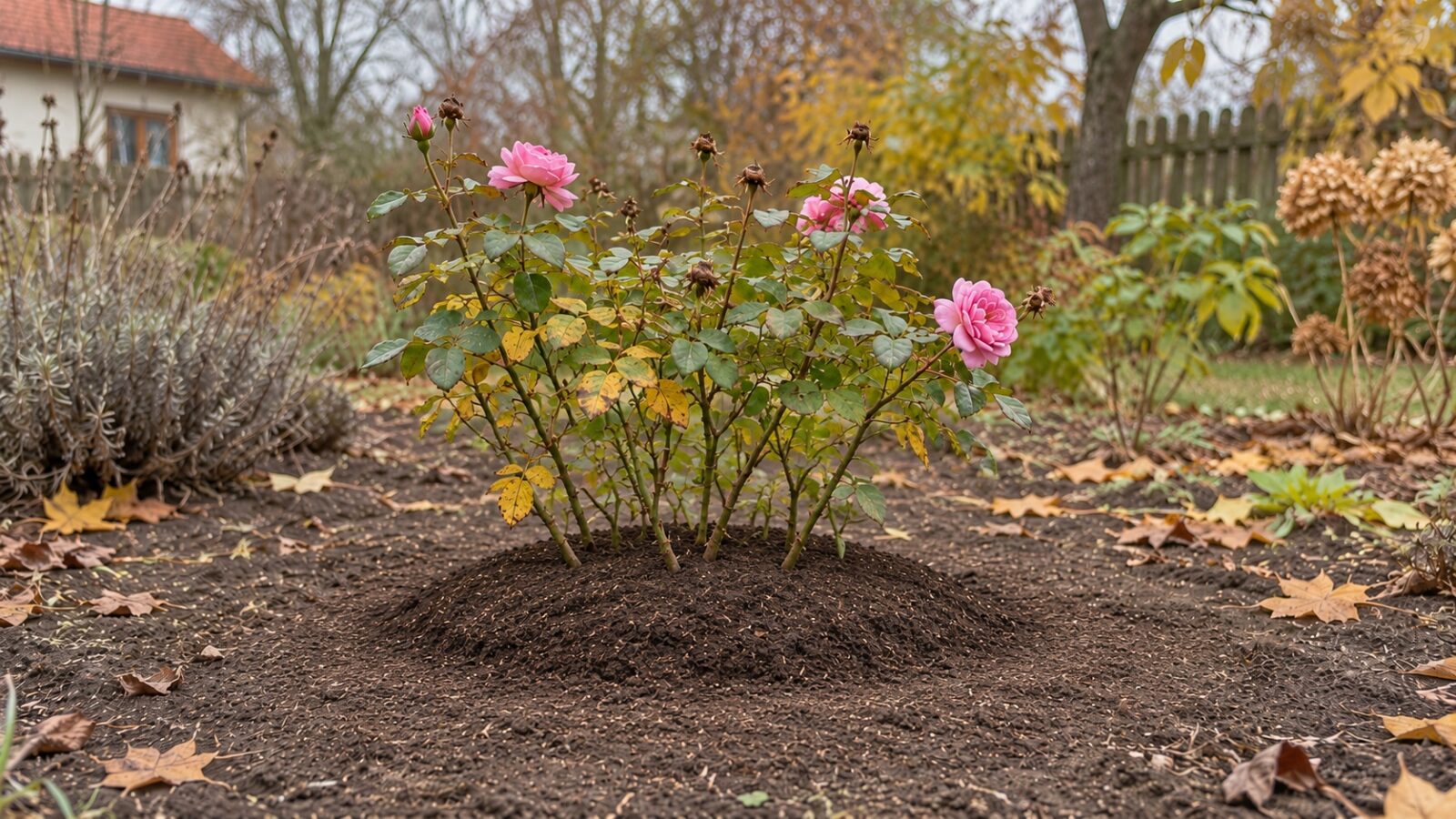
Bedding and shrub roses usually do fine with a well-made soil mound. More tender varieties will appreciate an extra layer of evergreen boughs, added only when colder weather arrives. Covering too early can do more harm than good, as can airtight plastic sheeting or leaving diseased fallen leaves under the plant.
Standard (tree) roses are a special case, because the graft union sits high in the head. A soil mound won’t help there, so the top needs protecting with horticultural fleece, or the stem must be carefully bent down and covered. Climbing roses mainly need protection from wind. In colder areas, less hardy types are sometimes taken off their supports and protected closer to the ground. Roses in containers are most at risk because their roots aren’t insulated by surrounding soil. The pot should therefore be wrapped and moved to a sheltered position.
When roses should be ready for winter
There’s no single date for the whole country, because the weather varies greatly by region and from year to year. Colder, higher gardens should act without delay; in warmer lowlands there’s often a short buffer. Even so, it’s sensible to have protective mounds finished by late October or early November at the latest, so a sudden temperature drop doesn’t catch your roses out.
In spring, gently pull the mound back, but again without scraping right at the base of the plant. Light frost alone usually won’t kill a rose; the far bigger threat is exposed or damaged roots and repeated freeze–thaw cycles. That’s exactly why it matters where you take the soil for winter protection from.
Source: The Spruce, RHS, Gardeners World, Pestrazahrada.cz

A lover of nature, gardens, and everything that moves, blooms, or grows. He literally grows everything, from herbs to rare species, and he enjoys caring for animals just as much. In his work, he connects modern technology with tried-and-tested grandmotherly methods and is happy when both paths lead to the same goal.
Related articles

Why Leave Old Plant Roots in the Bed Instead of Pulling Them Out
Instead of yanking out healthy spent plants, cut them off at soil level and leave the roots to break down in place. It improves soil structure, feeds soil life, and saves time with no downside in most beds.

Experienced gardeners don’t throw leaves away and use them in six smart ways
Fallen leaves are a valuable, free resource that feeds soil life, improves structure, and protects plants. Use them as mulch, compost, leaf mould, lawn feed, winter insulation, and wildlife habitat.

What to Do with Chrysanthemums in November So They Last Longer
Chrysanthemums brighten late autumn, but the first cold nights can cut their display short. With the right November care, many will flower longer and some can be kept for next season.
Comments (0)
Be the first to comment.