
 English
  Polski
  Deutsch
  Nederlands
  Svenska
  Norsk
Norsk  Dansk
Dansk  Français
  Italiano
  Español
  Português
  Slovenčina
  Suomi
Suomi  Gaeilge
 When a Pear Tree Declines How to Spot Pear Rust and Prevent Further Damage
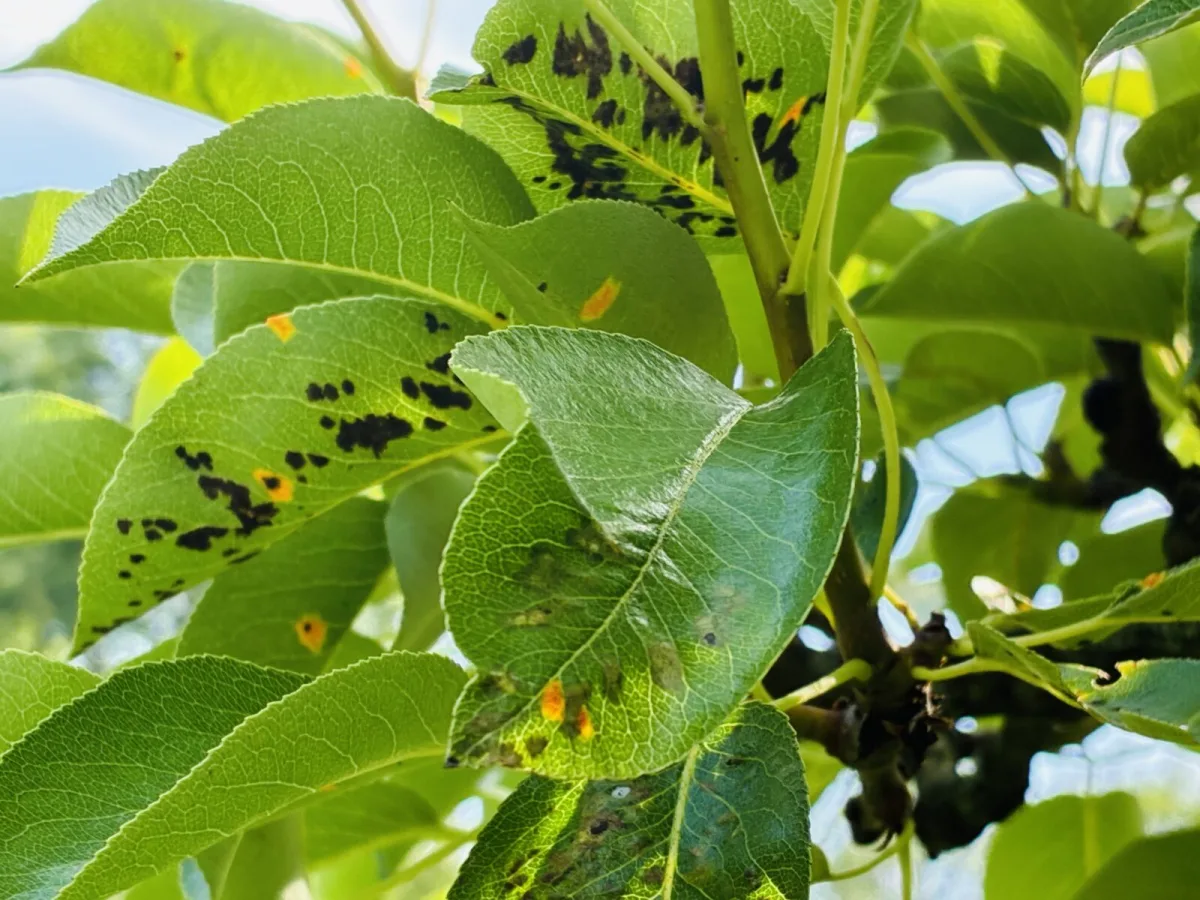
Pear rust is a fungal disease that attacks pear trees and also certain junipers. It is caused by the fungus Gymnosporangium sabinae. On pear, it most often shows up in summer and early autumn as vivid orange spots on the upper surface of the leaves. On junipers, the problem is long-term: the fungus can persist in their tissues for years and forms permanent swellings on the branches.
It’s important to understand that this disease needs both hosts to spread. Without both pear and juniper, its life cycle cannot be completed. That’s why a pear tree can look healthy for several seasons, but once there’s a suitable juniper nearby and the weather turns favourable, rust can appear quite quickly.
How to recognise infection on pear trees
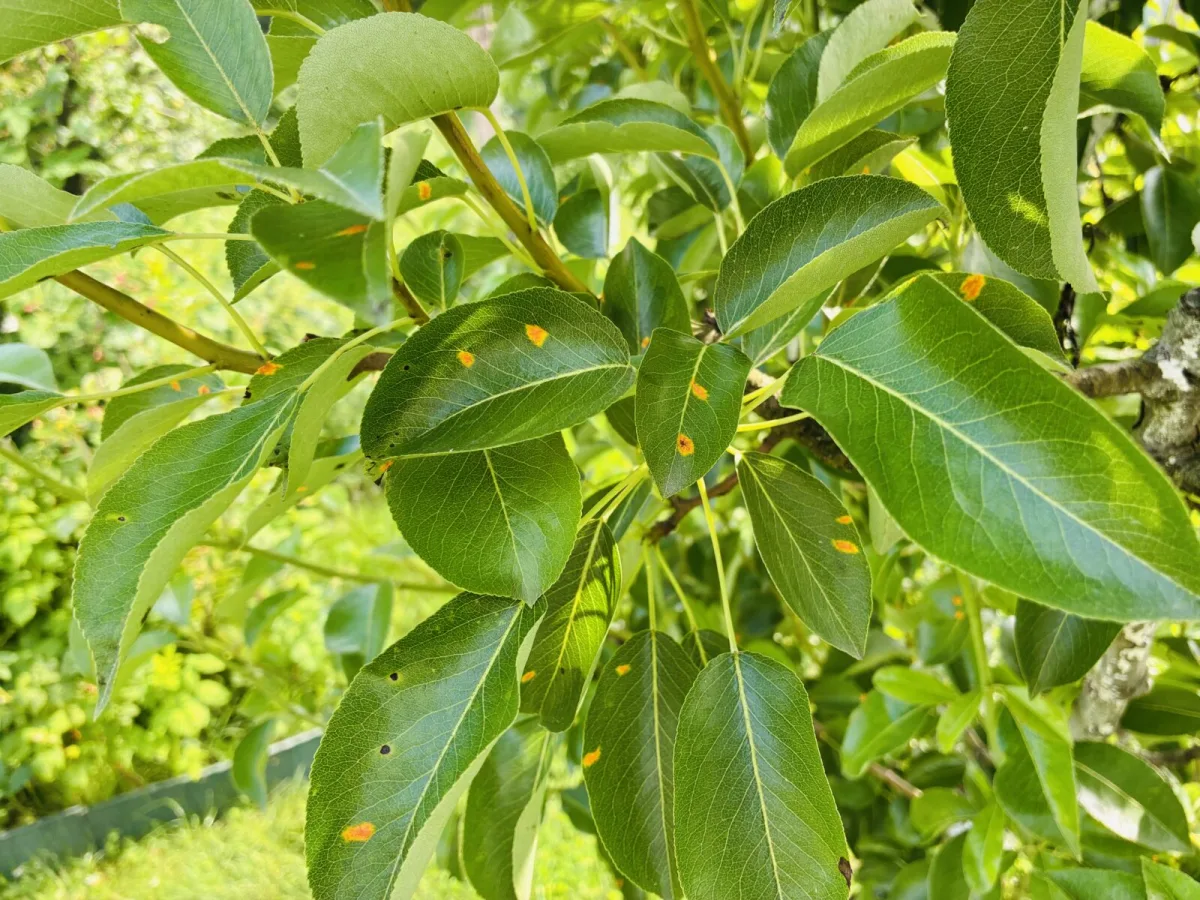
The most obvious symptom is bright orange spots on the upper surface of the leaves. They often look as if the leaf has been painted or scorched with colour. As summer goes on, brownish growths begin to form on the underside of the leaf where the spots are. They resemble tiny warts or galls, and these structures are crucial for the next stage of the disease’s spread.
Fruit can be affected too, but in practice it’s less common. In some parts of Europe, the fungus can also show up as long-term damage to the bark on branches—persistent lesions that are especially risky for young trees. In our conditions this is more the exception, but it’s still worth keeping an eye out for suspicious areas on branches.
How rust shows up on junipers
On junipers, the disease does not appear as leaf spots. The typical sign is permanent swellings on stems and branches, which can persist for several years. In spring, especially after wet weather, orange, jelly-like to gelatinous growths appear at these sites. This is when juniper becomes the source of infection for nearby pears, because spores are released from these growths and carried on the wind.
Why treating just one plant isn’t enough
Pear rust is a type of rust that draws nutrients over the long term from the host’s living cells, but it usually doesn’t kill the plant outright. At the same time, it does not survive well on dead material. That’s why the ability to switch between two hosts is essential. On pear, spores are produced that won’t infect pear again, but they can infect selected juniper species. The juniper then produces another type of spore in spring, which returns to pear.
Spore spread by air can also reach fairly large distances. That means even if you have no juniper in your own garden, the infection source may be somewhere in the wider area. Conversely, a juniper in an ornamental planting can significantly increase the risk to pear trees, even if the juniper is only a small shrub.
How to proceed without chemicals
The most effective approach is a combination of good growing practice, hygiene, and sensible planting decisions. On junipers, careful pruning out of infected parts helps when infections are clearly localised. In some situations, the simplest and most reliable solution is to remove juniper from close to pear trees, because it breaks one link in the fungus’s life cycle. However, bear in mind it may not solve everything, as spores can also blow in from elsewhere.
On pears, it can be tempting to remove infected leaves, but on heavily affected trees this can weaken the tree instead. If a tree loses a large part of its leaf area, its ability to feed the crop and build reserves for the next season is reduced. It’s better to monitor overall vigour and focus on helping the pear tree grow strongly.
If you notice suspicious, persistent damage on pear branches, it’s best to cut it out in time back into healthy wood. Make the cut so the wound can dry well, and keep tools clean—overall you reduce the risk of further infections and stress to the tree.
Fungicides and why they’re approached cautiously
With pear rust, it’s often recommended to prioritise non-chemical methods. Fungicides may, in some cases, limit symptoms of fungal diseases, but they can also negatively affect biodiversity, impair soil health, and have wider impacts on the surrounding environment. If you do consider chemical control, it’s essential to follow safe-use rules for application, storage, and disposal, and to use only legally approved products for that purpose.
In practice, the situation is complicated by the fact that home growers often don’t have ready access to products aimed specifically at rust on pears—especially if you intend to eat the fruit. That makes prevention, managing nearby plantings, and overall tree condition even more important.
How the disease spreads through the year
During summer, brown growths form on the underside of pear leaves. These release spores that are carried by the wind to junipers, where they cause long-term infections of branches. In spring, especially in damp conditions, juniper then produces conspicuous orange, jelly-like growths. More spores are released from these and spread through the air to infect pear leaves again. That’s why you most often see spots on pear in summer and early autumn, while juniper is the main infection source in spring.
Distribution and possible effects on yield
In the past, pear rust was more typical of mainland Europe and in some areas appeared only rarely. In recent decades, however, it has been reported more frequently in other regions as well, and on susceptible trees heavy infection can contribute to reduced yields. Typically it isn’t a one-off issue, but a recurring disease pressure in places where pear trees and suitable junipers occur together and the weather favours spore spread.
The best strategy is therefore a long-term one: keep pear trees in good condition, regularly check junipers nearby, intervene with pruning where it makes sense, and accept that complete eradication is rarely easy if the infection source is in the wider area.
Source: Rhs, Wikipedia , Pestrazahrada.cz
Related articles
An Orchid That Only Grows but Won’t Bloom Has Three Common Causes You’ll Never Fix with Fertiliser
If your orchid looks healthy but refuses to bloom for months, the cause is usually not a lack of fertiliser. Light, watering habits, and temperature patterns are far more often to blame.
Winter is crucial for raised beds and most people skip the pest prevention step
Your raised beds don’t go dormant just because winter arrives. A few quick, well-timed tasks now will protect the soil, discourage pests, and set you up for a smoother, more productive spring.
When to Mow the Lawn for the Last Time Before Winter
There’s no universal date for the season’s final mow—your lawn and the weather will tell you. Time it just ahead of hard frost and leave the grass slightly higher to help it overwinter healthier and bounce back faster in spring.
Comments (0)
Be the first to comment.