
 English
  Polski
  Deutsch
  Nederlands
  Svenska
  Norsk
Norsk  Dansk
Dansk  Français
  Italiano
  Español
  Português
  Slovenčina
  Suomi
Suomi  Gaeilge
 Why Your Onions Aren’t Thriving and the Most Common Mistakes with Easy Fixes
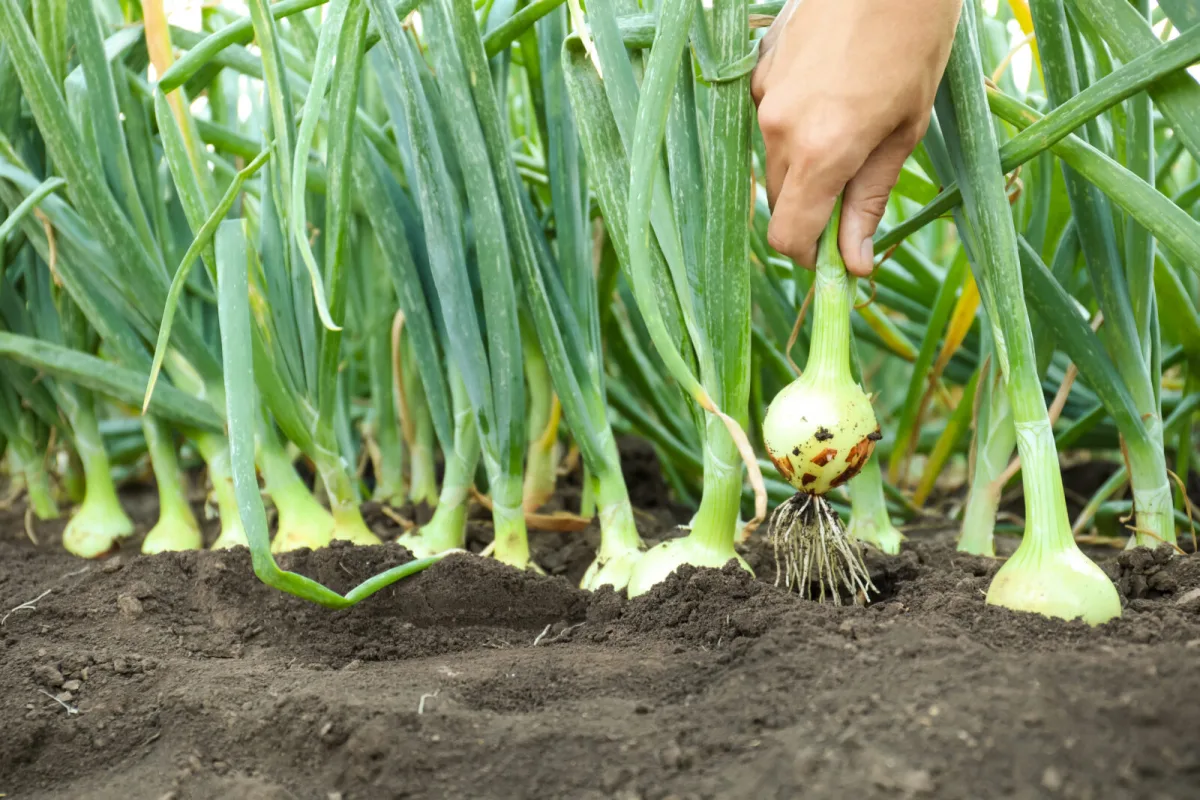
Onions are a kitchen staple, and in the garden they reward you with long storage life. Anyone who grows them regularly soon learns that no two seasons are the same. Onions are sensitive to weather swings, day length, and soil conditions, so even with good care results can vary. That’s exactly why it makes sense to plant more than you think you need and, at the same time, avoid the most common blunders that lead to leafy tops rather than proper bulbs.
Choosing a variety by day length can make or break your crop
One of the most common mistakes is buying the wrong onion type for your latitude. There are short-day, long-day, and intermediate-day varieties. If you choose poorly, the plant may produce plenty of healthy green leaves, but the bulb won’t properly form. In practice, success doesn’t start with feeding or watering, but with whether that variety can actually bulb up under your conditions.
When buying online, this mistake is even more common because descriptions tend to be vague, and it’s easy to pick a variety meant for a different latitude. The safest approach is to check recommendations for your region from local sources, rather than relying only on the experience of gardeners in a different climate.
Onion sets, transplants, and when each choice makes sense
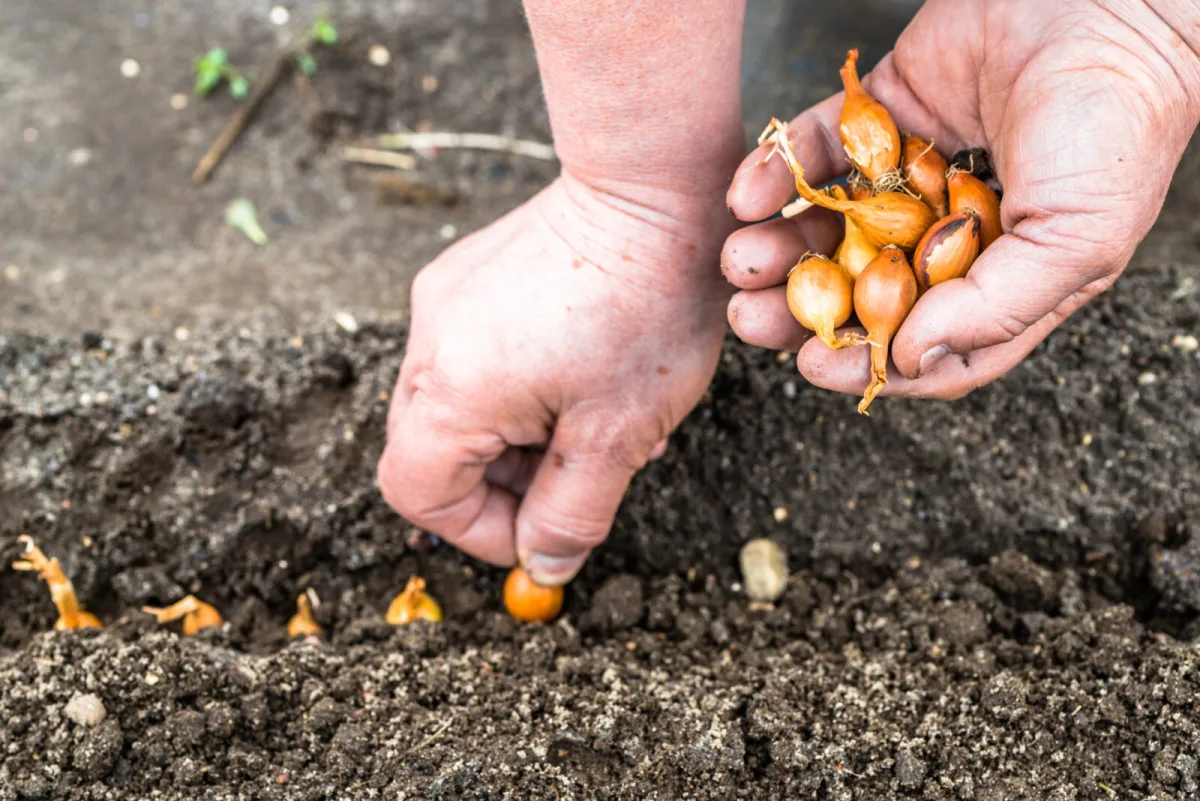
More confusion comes from whether to plant onion sets or transplants. Sets are small dormant bulbs; transplants look like young spring onions with roots. Many beginners buy sets in good faith expecting big bulbs, but the result often ends up being a harvest of tops. It’s not that sets are always wrong; it’s that they must match the right day-length type and be suitable for your area.
A simple rule applies: whatever you plant, always confirm the variety is right for your conditions. Advice from another part of the country may not translate at all, so it pays to learn from local growers or regional guidance.
Bigger isn’t better with transplants or sets
When choosing planting material, it’s tempting to pick the biggest pieces because they look the strongest. With onions, that can be a trap. The ideal transplant is roughly pencil-thick. Overly thick transplants are more prone to stress, may bolt, and the resulting bulb is often lower quality.
Similarly, with sets it’s worth sorting by size. The largest are better for green onions, while medium sizes usually have the best potential to form larger, well-storing bulbs.
Growing from seed requires a very early start
Attempts to grow onions from seed most often fail because of poor timing. Onions need a long period to build enough leafy growth to feed the bulb later. If you start sowing too late, you’ll end up with weak plants that don’t have time to size up properly before conditions trigger bulbing.
In warmer areas, where onions switch into bulbing earlier, you need to sow among the very first crops of the season. In general, it helps to plan sowing about 10 to 12 weeks before the average last frost date, so transplants have a head start.
Correct planting depth and spacing directly affect size
A common mistake is planting too deep. Transplants usually only need to be set about 2.5 cm into the soil, just deep enough to keep the plant upright. If planted unnecessarily deep, it can reduce airflow around the neck and increase the risk of problems as the bulbs mature.
Spacing is just as important. If you want larger bulbs, give onions room. Spacing of roughly 15 to 20 cm supports width growth because each plant has more water and nutrients available and doesn’t have to compete with its neighbors.
Feeding is often underestimated
Onions may look modest, but they’re hungrier than many people think. The key is supporting leaf growth, because the leaves are the energy store for later bulbing. If the tops are weak and pale green, it’s often a sign the plant is short of nitrogen or nutrients overall.
In practice, you can top up nutrients gently without synthetic fertilisers, for example with well-rotted poultry manure or other organic nitrogen sources. The important thing is to feed in time, so the plant can build a strong leaf canopy before it shifts focus to the bulb.
Watering must be consistent, but soil must not stay waterlogged
Onions like even moisture. If they suffer drought for a long time, they can respond with stress and later bolt more readily. At the same time, they hate waterlogging and heavy soil that holds water. Growth slows, and the risk of rot increases.
If you have clay soil, improving structure with organic matter helps, or grow in a raised bed where water drains faster and roots get more air.
Without full sun, big onions are hard to grow
Because onions aren’t a fruiting crop, it’s easy to assume they’ll cope with partial shade. In reality they love full sun, especially in the first part of the season when they’re building leaves. If light is limited, the tops stretch, weaken, and the bulb is usually smaller.
When combining crops, make sure taller plants don’t shade onions during the period when they need the most energy for growth. Pairings work best with plants that don’t shoot up aggressively and still leave onions plenty of light.
Weeds are the quiet competitor for water and nutrients
Onions don’t tolerate competition well because they have a relatively fine root system and high demands for moisture and nutrients. If weeds take off in the bed, they steal what matters most and growth quickly slows.
In the first weeks, careful hand weeding is often necessary. Once plants are stronger, mulch helps suppress further weeds and also stabilises soil temperature and moisture. A steadier environment also reduces stress that can lead to bolting.
Bolting stops bulb growth
When an onion bolts, a firmer central flower stalk appears with a distinctive pointed tip; it thickens and heads for bloom. For gardeners, that’s the sign the plant is switching from bulbing to seed production. The result is a smaller onion and, above all, poorer keeping quality.
Once an onion bolts, it’s best to harvest it as soon as possible and use it fresh or process it, because it’s no longer suitable for long storage.
High temperatures can trigger it, but sharp swings between warmth and cold are often even more damaging. Mulching helps, and in hot spells more careful watering prevents extremes. Don’t cover bulbs that start pushing out of the soil
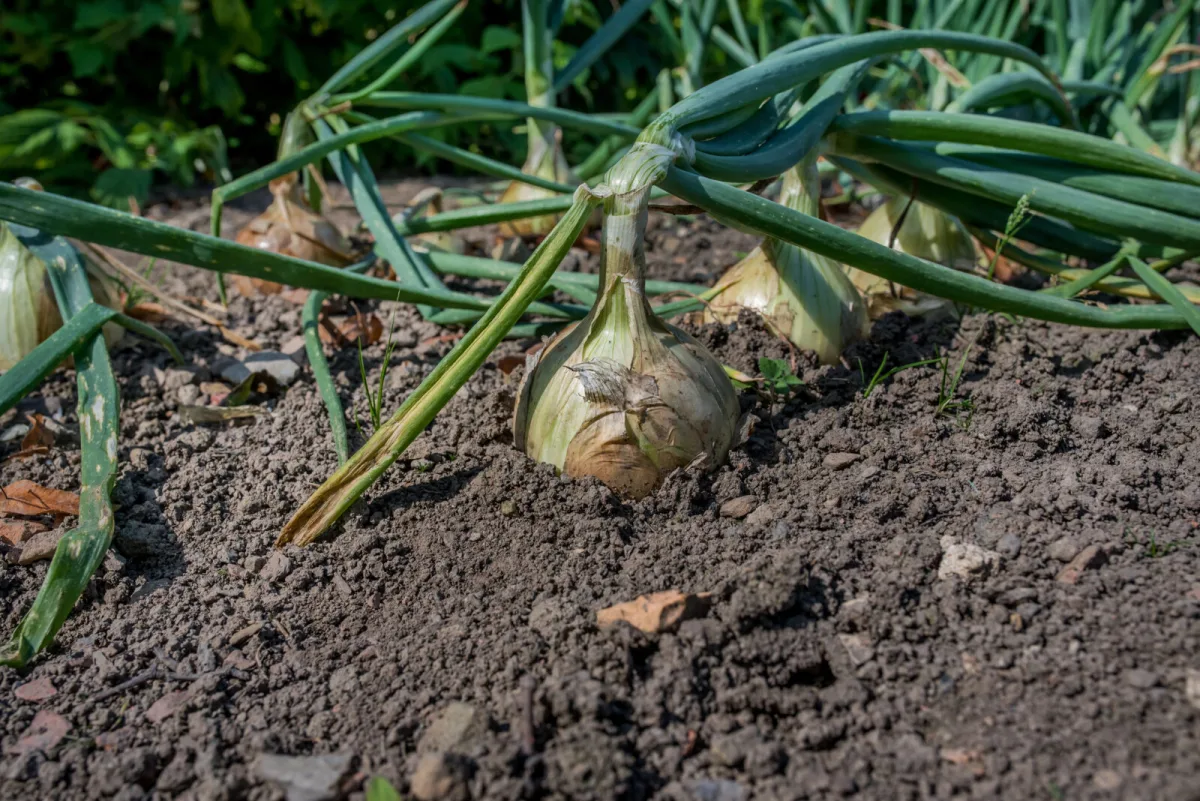
Towards the end of the season, it’s normal for the top of the bulb to show above the soil. Instinct says to pull soil back over it, as you would with potatoes, but with onions this can do harm. Covering the neck slows drying and can encourage rot, which then worsens storage.
Don’t bend the tops, onions will tell you when to harvest
Some advice suggests bending and laying the tops down at the end of growth so the onion supposedly swells faster. In reality, you’re robbing the plant of its final feeding phase, because sugars and energy move into the bulb from the leaves. If you damage the leaves, the bulb usually won’t improve; more often it’s the opposite.
You’ll recognise the right harvest moment when the tops fall over on their own. That’s when the onion is mature and ready to lift and then cure thoroughly.
The best final advice is to follow local conditions
Onions are one of the crops where recommendations vary most by region. Planting dates, day-length type selection, and feeding strategies all shift with climate. If you want more consistent results, lean on local sources, experienced growers nearby, and guidance from regional institutions. And if you’re still refining your approach by trial and error, that’s completely normal with onions; the key is to gradually remove the mistakes that keep repeating.
Source: Journey With Jill, Rhs , Pestrazahrada.cz
Related articles
The Christmas Amaryllis That Can Bloom for Years but Most People Throw It Away After Flowering
Hippeastrum is a spectacular winter-blooming bulb that, with the right care, will flower again year after year. Learn how to plant it correctly, look after it after flowering, and bring it into dormancy so it reliably reblooms.
How to Grow Winter Garlic for a Much Bigger Harvest
Autumn planting is the key to strong, healthy winter garlic, but the details make all the difference. With the right timing, bed choice, seed-clove treatment and a simple bicarbonate trick, you can noticeably boost yield.
A tree or shrub planted properly in autumn can outpace spring stock and improve fruiting
Many fruit trees and soft-fruit shrubs establish better when planted in autumn, because roots keep growing while the top is dormant. Done well, this head start means stronger spring growth, less watering, and a healthier first year.
Comments (0)
Be the first to comment.