
 English
  Polski
  Deutsch
  Nederlands
  Svenska
  Norsk
Norsk  Dansk
Dansk  Français
  Italiano
  Español
  Português
  Slovenčina
  Suomi
Suomi  Gaeilge
 Mandevilla as the Successor to Geraniums That Loves Full Sun and Brightens Any Balcony
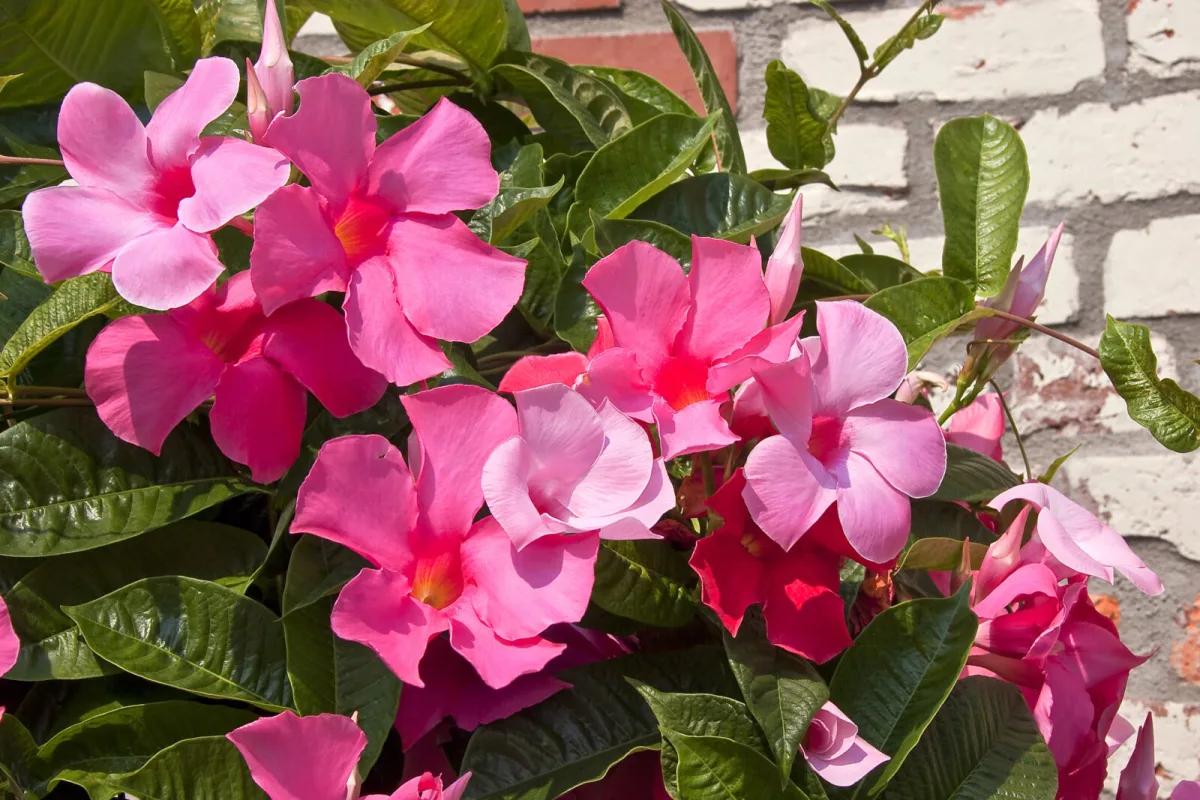
You’ll often spot it in a garden centre right by the entrance, because it blooms more boldly than many of the usual balcony favourites. Mandevilla has quickly earned a reputation as a plant that can light up a terrace, balcony or the area by the front door with long waves of flowers. While other blooms struggle in scorching weather, it usually only starts showing what it can do in warmth and direct sun. You can grow it as a climber with support, but it looks just as striking in a trailing form, spilling from a pot like a lush, flowering waterfall.
Exotic origins and why it feels surprisingly at home here
Mandevilla, which you may also know under the older name dipladenia, comes from the tropical regions of Central and South America. In the wild it grows as a vigorous, woody vine and, in favourable conditions, can climb several metres. For cultivation in Europe, more compact varieties have been bred that are easier to keep in a pot, while still holding on to their tolerance of high temperatures. That’s exactly what makes it a reliable choice for spots that get hot in summer and where the air by house walls heats up the most.
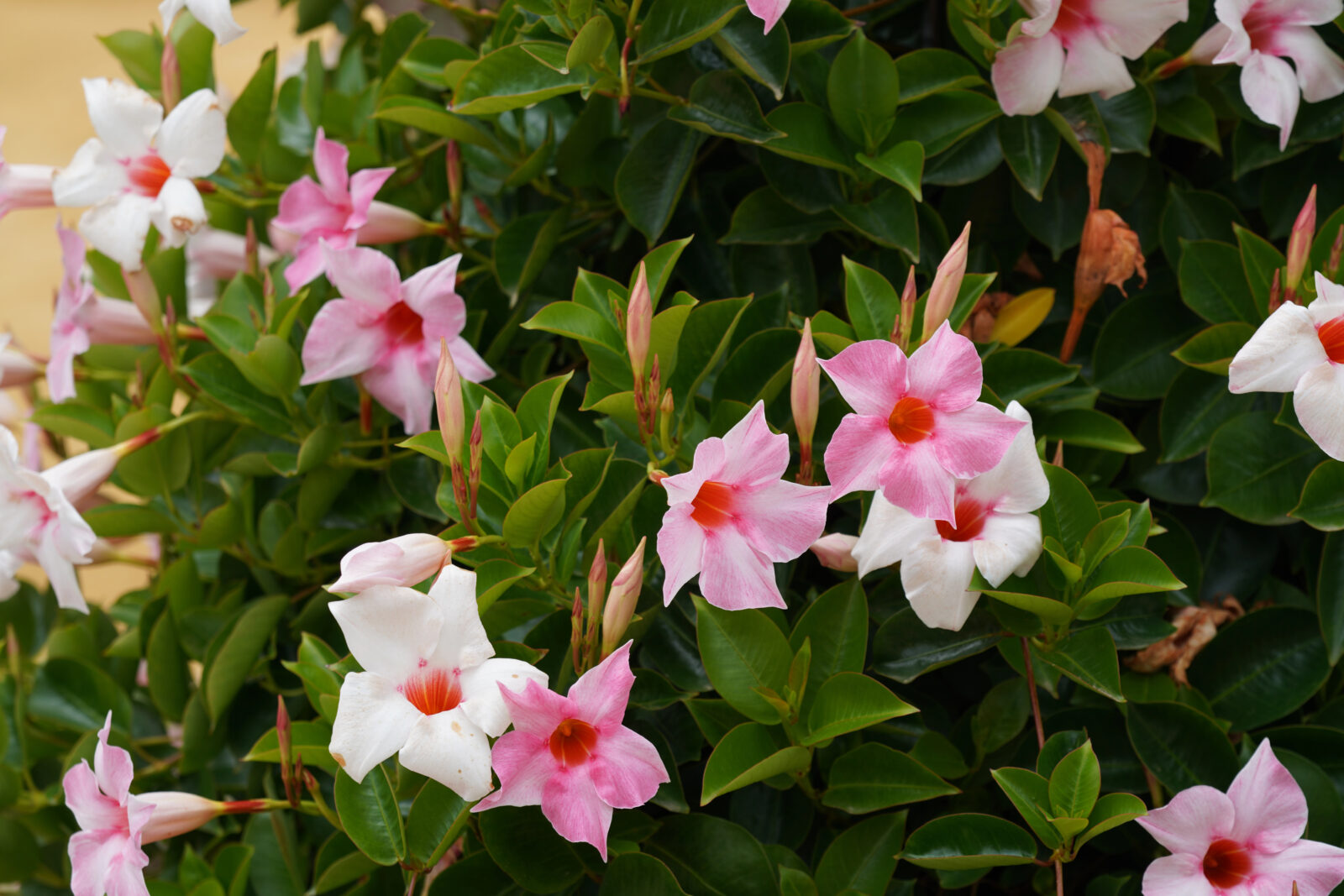
The flowers come in a broad palette of shades, from pure white through soft pink to deep purples and the popular velvety reds. The look is completed by firm, glossy, dark-green leaves that appear luxurious even outside the main flush of bloom.
The best position on a balcony or terrace
Warmth and light are key for mandevilla. The more direct sunshine it receives, the more readily it sets buds and the longer it keeps flowering abundantly. It will survive in partial shade, but it will usually produce fewer flowers and the overall effect won’t be as dramatic.
Sunny aspects are ideal, typically a south-, west- or south-west-facing balcony. Climbing types are best guided onto a support such as a trellis, pergola or at least a bundle of bamboo canes, which they quickly cover. If you choose a trailing form, you’ll get a dense flowering cascade that holds its own next to trailing geraniums and petunias.
A practical advantage of mandevilla is its ability to self-clean: spent flowers usually drop off on their own, without the need for deadheading by hand.
Compost, watering and feeding for long flowering
Even though mandevilla can cope with heat, it still needs balanced conditions in a pot. The foundation is an airy compost that holds reasonable moisture while also draining excess water quickly. A good option is a compost for patio and balcony plants, improved with something to boost drainage, typically sand or perlite. Adding some peat is also a common choice, as it helps keep moisture more even without suffocating the roots.
With watering, it’s important to find the right line. Mandevilla likes a regular drink but doesn’t tolerate waterlogging. Its firm, leathery leaves manage water efficiently, so it usually copes better with short dry spells than with constantly wet compost. Water only when the top layer of the compost has clearly dried out. Overwatering can lead to root problems and a gradual decline of the whole plant.
Because it produces a large number of flowers, it needs a steady supply of nutrients. A standard feed for flowering plants works well, ideally with an emphasis on phosphorus and potassium. During the season, feeding once every one to two weeks is usually enough, following the manufacturer’s guidance and adjusting to how intensely the plant is flowering.
Two ways to overwinter mandevilla safely
Mandevilla is a perennial, but it won’t survive frost. That’s why it’s grown mainly in containers here, so it can be brought in on time in autumn. Outdoors it does well from the second half of spring until autumn; you just need to watch for cold snaps. A sign that it has become too chilly where it’s sitting can be a sudden drop of a larger number of leaves.
The first option is to overwinter it in a warmer indoor space, much like a houseplant. It helps to remove old leaves, pinch out dry parts and check any broken shoots. If it has enough light, it will cope with normal watering and very light feeding, and it may even flower sporadically through winter.
The second route is a true winter rest with a hard cut-back. Shoots are pruned to about 30 to 40 cm and the pot is moved to a bright but cooler place, roughly around 10 to 15 °C. A conservatory, an unheated hallway, a bright workshop or a garage can be suitable. In this regime, feeding is stopped completely and watering is reduced to the bare minimum, often just once a month, so the root ball doesn’t dry out entirely.
If overwintering doesn’t work, propagation from cuttings can help
For many growers, even with the best effort, an older plant doesn’t make it through winter in good condition. If you don’t want the hassle of moving a large pot or you lack an ideal overwintering spot, you can safeguard next year’s display by taking cuttings in late summer. Indoors, you can raise young, compact plants over winter, then gradually harden them off in spring and move them back outside into the sun.
Safety when pruning and handling
When you cut or snap shoots, mandevilla releases a white, sticky sap. It is poisonous and can irritate the skin, so it’s sensible to work with gloves and avoid contact with the eyes. Always wash your hands after pruning, and don’t leave broken pieces where children or pets could reach them.
If you give it sun, an airy compost, careful watering and regular feeding, mandevilla will reward you with a long flowering season and a bold exotic look that can easily make your balcony the most eye-catching spot for miles around.
Source: Urob si sám, Gardener’s World, Pestrazahrada.cz

A lover of nature, gardens, and everything that moves, blooms, or grows. He literally grows everything, from herbs to rare species, and he enjoys caring for animals just as much. In his work, he connects modern technology with tried-and-tested grandmotherly methods and is happy when both paths lead to the same goal.
Related articles
The Christmas Amaryllis That Can Bloom for Years but Most People Throw It Away After Flowering
Hippeastrum is a spectacular winter-blooming bulb that, with the right care, will flower again year after year. Learn how to plant it correctly, look after it after flowering, and bring it into dormancy so it reliably reblooms.
How to Grow Winter Garlic for a Much Bigger Harvest
Autumn planting is the key to strong, healthy winter garlic, but the details make all the difference. With the right timing, bed choice, seed-clove treatment and a simple bicarbonate trick, you can noticeably boost yield.
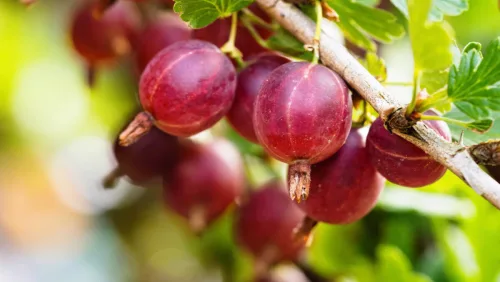
A tree or shrub planted properly in autumn can outpace spring stock and improve fruiting
Many fruit trees and soft-fruit shrubs establish better when planted in autumn, because roots keep growing while the top is dormant. Done well, this head start means stronger spring growth, less watering, and a healthier first year.
Comments (0)
Be the first to comment.